The Nim programming language is preparing for a 1.0 release with a stability guarantee!
miniblog.

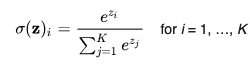
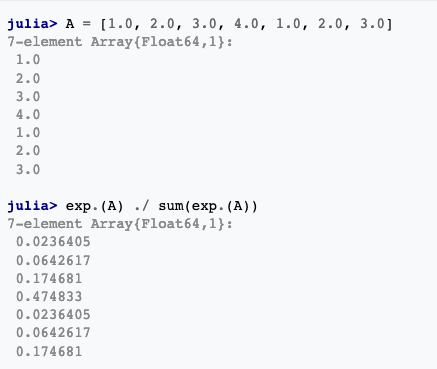
Julia syntax is lovely: I really like how you can add a . to make it distribute over an array.
Looking at https://en.wikipedia.org/wiki/Softmax_function, compare the raw formula with the Julia syntax.
Typescript has an interesting approach to type checking: it will emit JS even if the code isn't well-typed! https://basarat.gitbooks.io/typescript/docs/why-typescript.html
(This is a nice property of gradual typing: you can run unit tests on refactored code even when some code still uses the old API.)
TIL eager macro expansion can mean very different things.
Rust macros must expand to valid code, so eager macro expansion allows illegal intermediate states: https://docs.rs/eager/0.1.0/eager/macro.eager.html#macro-expansions
Elisp macros are expanded at runtime unless expansion is eager:
Replacing npm (the tool and the organisation) with a federated alternative by npm inc's former CTO! https://www.theregister.co.uk/2019/06/04/npm_cj_silverio_javascript/
(I had no idea that so many registries were sprouting!)
straight.el https://github.com/raxod502/straight.el looks like a great alternative package manager for Emacs.
It checks out git repositories of dependencies, so it's always easy to contribute changes upstream! This has been a definite point of friction in my Emacs workflow.
I fear I no longer have much appreciation for what the typical level of computer literacy is.
I work on tools used by other developers, so a ton of my day-to-day life is not at all representative of the population at large.
Shower thought: often the value of tests is enabling you to make changes (they're less helpful if you never make code changes).
When deciding where to focus tests, we should probably focus on the parts with the most churn rather than the least coverage.
Prediction markets are a fascinating potential application for cryptocurrencies. The details of who and how a claim is verified are challenging though.
https://info.binance.com/en/research/marketresearch/augur-design-flaws.html
(But it looks like the several political outcomes are already available on UK betting exchanges.)
AWS is only 32% of global cloud computing spend: https://www.canalys.com/newsroom/cloud-market-share-q4-2018-and-full-year-2018
That's less than I expected! It's the biggest provider but there are a lot of popular options it seems.
Defining a subset of #[no_std] Rust, formally verifying it, and releasing it as 'Sealed Rust' for use in safety critical systems like automotive and avionics:

On the social function of multiplayer video games over telephone calls:

I suspect there's an analogy of blub programming languages for IDEs. Once you've seen more powerful solutions you miss them in less capable tools. If you haven't learnt them, you're indifferent.
This is probably why 'table stakes for a modern IDE' viewpoints vary so much.
In 2005 I was thinking about a career in tech. There was a best selling book called The World Is Flat that argued that you'd be competing with the entire world, including places with much lower living costs.
I make a living writing code in London. What happened?
Showing 2,116-2,130 of 7,653 posts