miniblog.

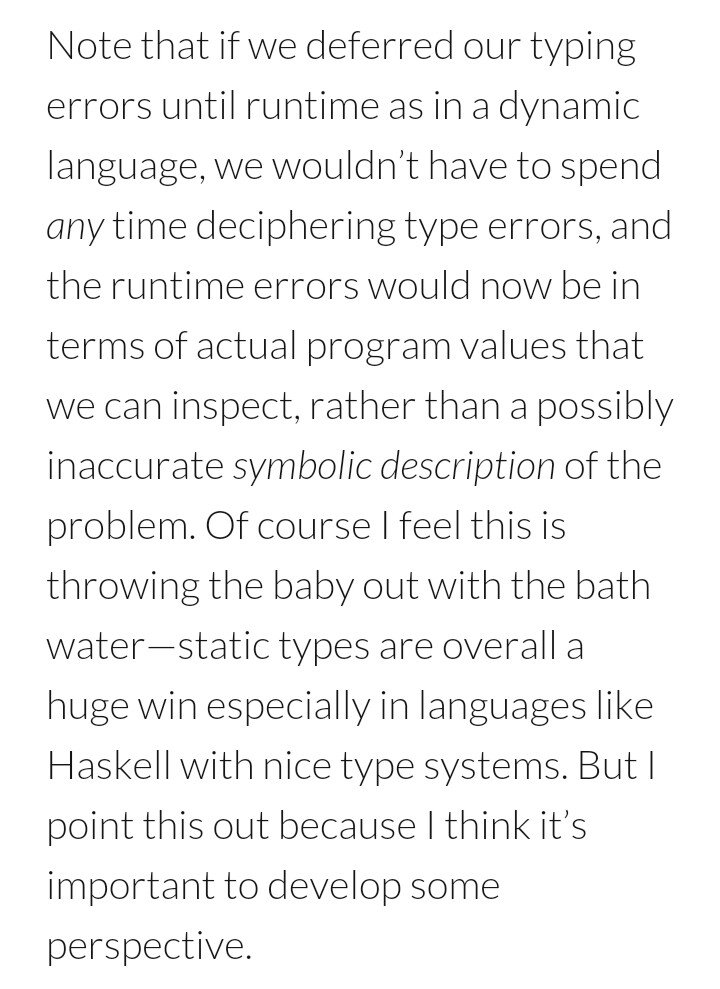
Dynamically types languages have the advantage of concrete values, so static languages *must* have helpful errors:
Photo
ripgrep is even faster than ag! https://blog.burntsushi.net/ripgrep/ Exciting! Rust (plus the talent of those involved) is preventing Wirth's law.
It is terrifying to learn that all Intel CPUs contain a separate system with full access and a network connection:
The MIT Lisp Machine manual argues in favour of allowing users to patch internal details of classes:
Photo
Interestingly, the FSF's biggest objection to GitHub is not the proprietary backend! https://www.gnu.org/software/repo-criteria-evaluation.en.html (it's the JS and censorship)
Emacs command of the day: ivy-read-action, bound to C-M-a when ivy is active. Change the action on RET before you choose a candidate!
I'm familiar with some pretty arcane Emacs keybindings, but I'm really impressed with C-φ in lispy!
Every time that I play with Pharo (Smalltalk), I miss something when I go back to my usual language tooling.
Viewing a codebase as an immutable, content addressable tree: https://unisonweb.org/2016-09-17/editing.html (enables some really interesting features!)
Sorted copyright assignment for @guilelang! Hurrah!
TIL there's a service on freenode that conveniently lists channels:
Emacs command of the day: crux-sudo-edit from https://github.com/bbatsov/crux . Great for editing the current file, if it's owned by root.
I've just discovered I can double performance of my elisp project by let-binding gc-cons-percentage to 0.8! Woohoo!
Apparently function calls are cheap in elisp. I rewrote a recursive function as iterative and was pleasantly surprised that perf matched.
Although 'time travelling debuggers' sound cool, I would find them easier to explain if we simply called them 'debuggers with undo'.
Showing 4,231-4,245 of 7,640 posts