We will enable the mobile equivalent of "View Source" http://t.co/WRiNZQfQ9c New directions for firefoxOS! I'd love a more hackable phone.
miniblog.
Blogged: Effective Developer Interviews: http://t.co/bb4yv9H2bY
https://github.com/klutzy/nadeko is an extraordinary Rust syntax extension that compiles code to constant time assembly. Remarkable and very useful.
I'm gradually transitioning to helm.It's possible to get a 'big minibuffer' style UI, and the filtering is nice even if you've mastered ido.
... although I've never met anyone who had internalised all Emacs builtins. Emacs is all about continually learning.
A sign of ag.el's success is that users are learning its commands before occur.el!

Emacs tip of the day: C-m is the same as RET, and C-i is the same as TAB. Give them a try, they can be more comfortable to type.
libexplain is an interesting library intended to make *nix error codes more friendly: http://t.co/lLMduUDx3y
Proposed an improvement to errors in the rust compiler, and a patch landed in less than a day. Seriously impressed.
Emacs tip of the day: (setq scroll-preserve-screen-position 'always) will ensure that M-v always undoes C-v, so you can go back exactly.
On a related note, moving to company has been one of the best things I've done to my Emacs configuration this year.
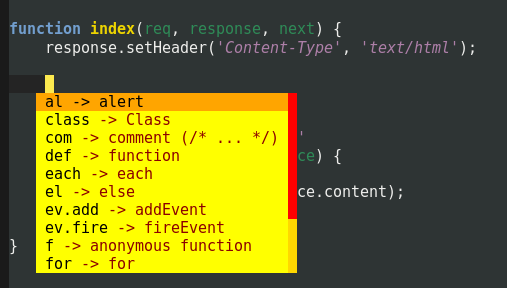
company-mode and yasnippet work brilliantly together. Try M-x yasnippet-company to see snippets available. http://t.co/KKdeEFPVtx
"Crates.io is reasonably complex, linking to libgit and such, and still uses roughly 25MB of RAM, constant." Impressive!
Rust 1.0 is out! Great language, wonderful community, excellent package tooling. I'm excited to see where it goes!
Wow, there are already Visual Studio plugins for Rust! http://t.co/Fy9QdAeLn2 -- A great omen for Rust on Windows.
Showing 5,356-5,370 of 7,653 posts