That happy feeling when you replace some handwritten code with an off-the-shelf library.
miniblog.
I've built a self-hosting metawiki! Demo site available at http://t.co/CS9NDfUXx4
I find putting a coveralls.io badge on my projects is a great incentive to review my tests and what functionality I'm exercising.
Considering how heavily node.js uses callbacks, it seems rather odd that it doesn't support TCO (I know it's hard in JS).
The arguments variable in JS is always there, but taking a parameter called 'arguments' overrides it in all scopes. It's a pseudo keyword!
Slightly terrified to learn that (boundp 'foo) is equivalent to (boundp' foo) in elisp. Made a typo, and it worked!
I like that if you make changes to answer on Stack Overflow, then immediately edit again, you can just continue where you left off. Humane.
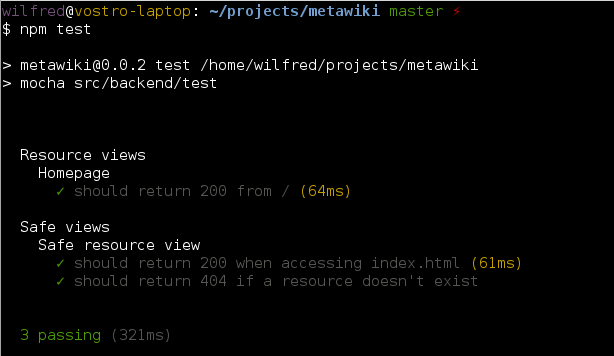
TIL you should use "use strict"; in node programs too. Caught me by surprise!
Stephen Covey describes stages of maturity as dependence, independence and interdependence. Mature FOSS contributors/projects do the latter.
So much great work is going into Julia, and 0.4 is fixing all my pet peeves:
I admire people who say "sure, I use GUI applications sometimes, and start an X server then". Not quite enough to emulate them though.
I'm enjoying trying RequireJS for a project. I'd always understood it as a tool for loading, missing the benefit of its module definitions.
Errors vs. Bugs and the End of Stupidity http://t.co/U9MOfWTTZq
Pip is great, but sometimes I wonder if one of the original motivations was simply that it's less to type than the 12 chars of easy_install.
Showing 5,416-5,430 of 7,653 posts