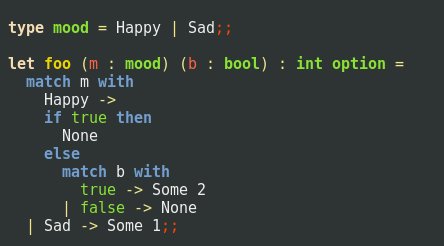
I'm learning OCaml at the moment, and I was caught out by the syntax today. This code (pictured) gives a type error saying that Sad is not a boolean. https://gist.github.com/Wilfred/ce4b7177f404a482b8fccc0044d15e4c
This is the classic 'dangling else' syntax problem, but with match statements rather than if statements.
miniblog.
Related Posts
I've released difftastic 0.62! In this release:
* Updated parsers for Bash, C, C++, C#, CSS, Go, Haskell, HTML, Java, JavaScript, JSON, Julia, Lua, Objective-C, OCaml, PHP, Python, Ruby, Scala, TOML, TypeScript and XML.
* Obligatory crash fixes.
I really like pattern matching in Rust, but I find myself using it less and less.
`if let` and `let ... else` require substantially less indentation, and I often use them for Option values.
I don't miss this syntactic sugar in OCaml though. Maybe it's just because OCaml has a 2 space indent, unlike Rust's 4 space indent?
I still find it weird that constructors aren't first class functions in OCaml.
`id Just` is legal in Haskell, but `id Some` is an error in OCaml.
Are there any advantages of the OCaml approach?