I've just added closure support to my toy programming language: https://github.com/Wilfred/garden/commit/d1fb4566a2187dfe98fb1d2278a7a0d2acd8059e
Closures are more fiddly than I expected, but I now have a much better understanding of what downward/upward funargs are :)
(Downward: passing a closure, upward: returning a closure)
miniblog.
Related Posts
12
I've been using "Expected Int, but got String" for my type error messages, but I've been wondering if I could do better.
"Expected Int here, but this value has type String" or "This expression requires Int, but the value is String".
Do you have a favourite?
326
There are *so many* ways that reading a text file can fail.
Maybe it doesn't exist, it's a broken symlink, it's actually a directory, it's not the encoding you expected, or perhaps you just don't have the correct permissions.
Reporting good errors is surprisingly labour intensive.
64
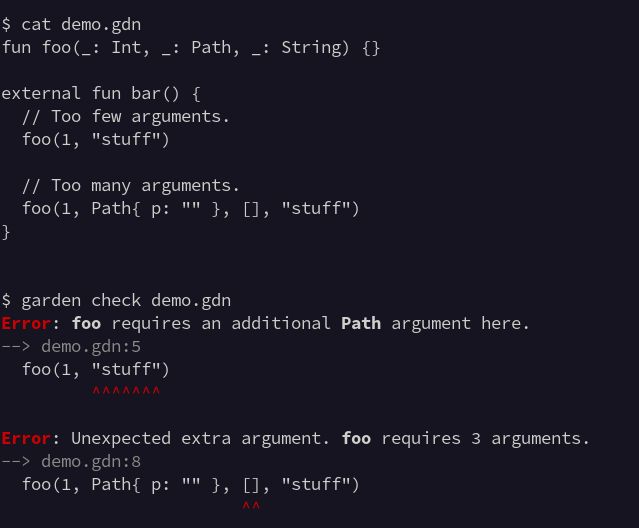
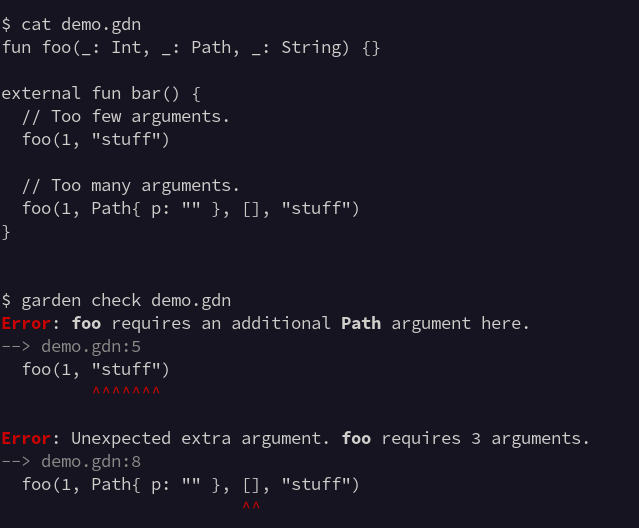
I'm working on arity errors in Garden, my toy programming language.
Rather than just saying "expected 3, got 4 arguments", I'm trying to report where the extra argument is, or what extra argument was expected.