Lua treats nil and false as falsy values, but not 0 (unlike python and JS). So little agreement as to what should be falsy!
miniblog.
Related Posts
27
Do users of immutable systems (i.e Nix or Guix) upgrade more or less often than other platforms?
There's less pressure to upgrade (unlike a rolling release distro) but in principle upgrading is easier.
I really like pattern matching in Rust, but I find myself using it less and less.
`if let` and `let ... else` require substantially less indentation, and I often use them for Option values.
I don't miss this syntactic sugar in OCaml though. Maybe it's just because OCaml has a 2 space indent, unlike Rust's 4 space indent?
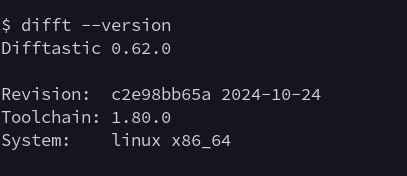
It's a small thing, but I'm much happier with the output of --version in the latest version of difftastic.
It shows the release version number, the commit hash, and the commit date. This gives you a sense of the age of release, but you still have a reproducible build (unlike build time).
It also shows OS, arch and compiler, because those are common requirements in bug reports.