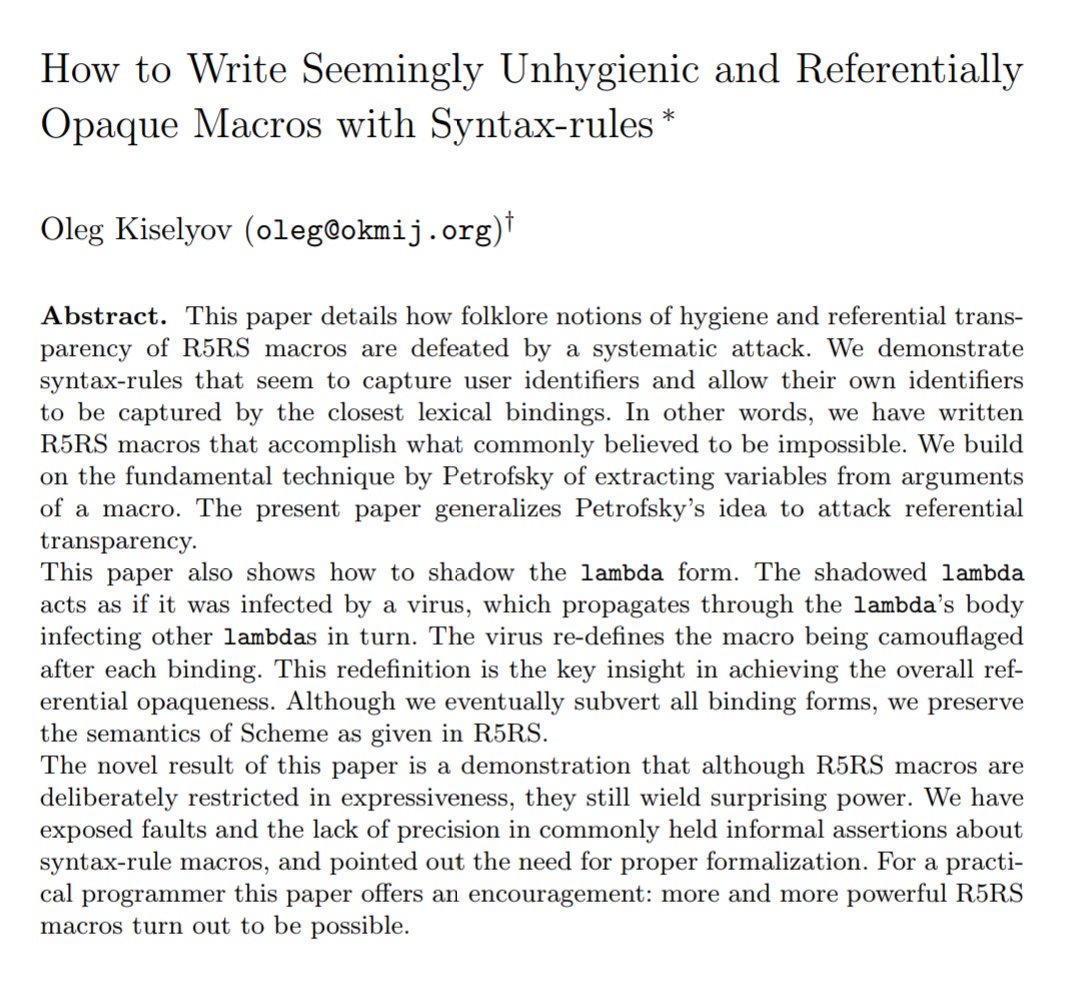
How to Write Seemingly Unhygienic and Referentially
Opaque Macros with Syntax-rules: a fun paper on macros in Scheme, and how you can subvert hygiene using only syntax-rules!
Related Posts
I'm changing method definition syntax in my language:
// old
fun (this: Int) inc(): Int { this + 1 }
// new
method inc(this: Int): Int { this + 1 }
The original syntax was inspired by Go, but the new syntax is more grep-friendly and perhaps more readable. Not sure about the verbosity though. Thoughts?
I'm having fun writing a simple type checker, but I'm learning firsthand why syntax-directed checking doesn't work. It prevents inference.
My checker catches real bugs, but it can't handle cases like this:
[1, 2].map(fun(x) { x + 1; })
I think I need bidirectional checking.
I'm experimenting with syntax in examples. I don't really like Rust's `assert(inc(1) == 2)` syntax, I find it a little distracting.
I'm trying `inc(1) //-> 2`. The comment is rendered differently, and there's nothing before the sample code. What do you think?