Documenting code in the first person: http://t.co/VH8EPYH5BI not seen that before!
miniblog.
I prefer learning programming languages by reading tutorials, but I've found screencasts essential for getting started with Smalltalk.
#Emacs package of the day: fancy-narrow. Available on a MELPA near you. Use cases: http://t.co/lQ4aJ6RqUc http://t.co/s0Q7NIHphd
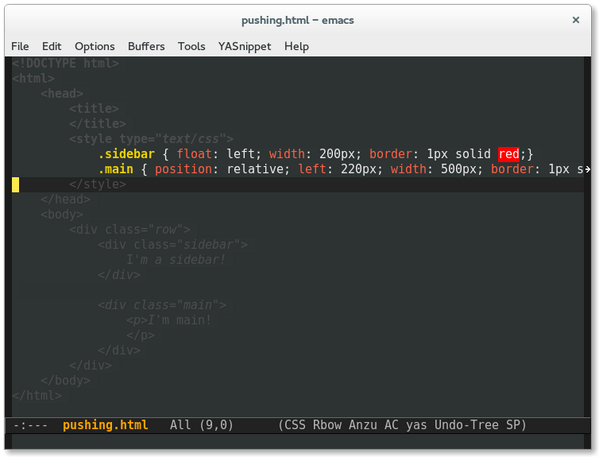
A Haskell project for uploading elisp code to a node.js website: http://t.co/MJFSG8A4QH (fun!) cc @lunaryorn
Emacs tip of the day: http://t.co/dGscbchZVm
Compiling Clojure to shell: https://github.com/pallet/stevedore . Sounds slightly bonkers, but effective (especially wrt improving startup time).
I'm gradually getting into org-mode. It has yet to revolutionise my life, but it's handy for taking notes with inline code.
'63 packages marked for upgrade' I feel I need to upgrade and test one-by-one. This is why I'm excited by stable packages on @melpa_emacs.
With Office available on a wide range of platforms, why bother with Windows? Only a few obscure games is the only reason I can see.
Interesting HN comment contrasting TDD and unit tests: https://news.ycombinator.com/item?id=7467853
I've seen ^L used in elisp source to break up code into screenfuls, but today I saw something similar in Python:
"The biggest reason to use twine is that python setup.py upload uploads files over plaintext." Cripes, I did not know that. #python #psa
py.test has this curious feature 'xfail', that allows you to ensure a test execute, but expect it to fail. Not sure I've had a need for it.
Travis version matrices are great. A few lines in .travis.yml and suddenly I'm testing against a wide range of dependency versions
Debugging a git-svn issue by using `git svn clone` on a GitHub subversion URL. I've come full circle!
Showing 1,021-1,035 of 1,323 posts