I've learnt complex languages in the past, but assembly has an incredibly intricate programming model. Tiny change->assemble->test.
miniblog.
I'm going to the London Emacs meetup tomorrow! https://www.meetup.com/London-Emacs-Hacking/events/230686750/ Do say hello if you're attending.

a prog by any other name https://www.tedunangst.com/flak/post/a-prog-by-any-other-name (interesting post on how programs see their own name, with a Unix focus)
The many advantages of the new advice system in Emacs:

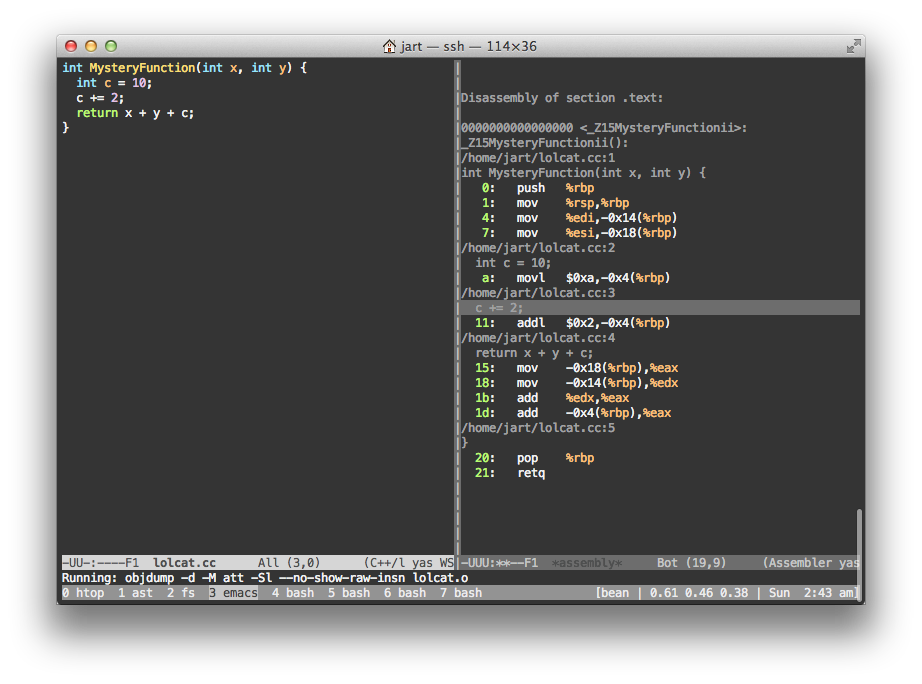
Emacs package of the day: disaster https://github.com/jart/disaster (a great way of learning assembly!)
Smart Languages and Dumb Parsers https://web.archive.org/web/20071229092212/http://glomek.blogspot.com/2007/12/smart-languages-and-dumb-parsers.html (on the relationship between syntactic sugar and metaprogramming)
Not convinced by org extensions that hide the original syntax. It's less explicit. Perhaps experienced users have internalised the syntax?
Io is designed to very embeddable, to the point that there are operating systems based on it! IoL4:
A very readable introduction to inline asm with gcc:
What is it about pastebins that invite spam? It seems spam is more endemic for pastebins than for other hosted services.
I am blown away by https://github.com/Malabarba/elisp-bug-hunter . Is an Emacs package setting a variable you didn't want? This pkg can bisect and find it.
Firefox increasingly supports -webkit CSS prefixes: https://wiki.mozilla.org/Compatibility/Mobile/Non_Standard_Compatibility (which is why vendors no longer like prefixes)
WebRTC will let users do voice calls, video calls or P2P file sharing just by visiting a website. I'm sure we'll see an explosion of apps.
Of C-style langs, I think C++ has the steepest syntactic learning curve. Reading C is easy after Java, but lambdas and init lists are novel.
Red is the most lispy language I've seen that doesn't use parens: https://blog.hostilefork.com/why-rebol-red-parse-cool/
Showing 586-600 of 922 posts