miniblog.
Oct 17, 2017
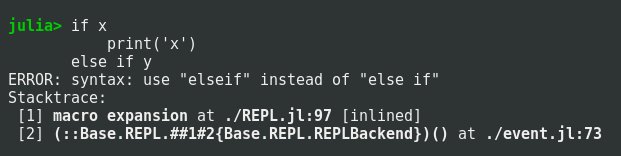
I love languages that go the extra mile with their syntax errors. Here's Julia being helpful when you write 'else if' rather than 'elseif'.
X / ?
Oct 17, 2017
The
@racketlang
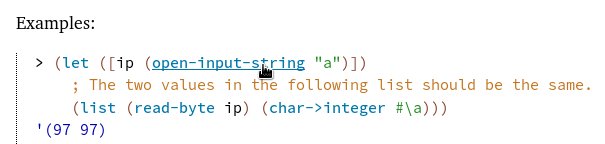
docs are superbly cross-referenced. Even the code examples convert the function names into links!
X / ?
Oct 16, 2017
Company dev blogs are very much underrated. Thread.
Oct 16, 2017
Julia's generated fns are like macros,but they have access to the type of fns!
https://docs.julialang.org/en/latest/manual/metaprogramming/#Generated-functions-1
(Other PLs call this staged fns AIUI)
The Julia Language
Repository for hosting the manual for the Julia language
Oct 16, 2017
Apparently the 140 character limit on tweets is only enforced clientside!
https://www.theverge.com/2017/9/27/16372666/twitter-280-characters-guide-workaround
Oct 16, 2017
Blogged: These Weeks in Remacs III:
These Weeks in Remacs III
programming, language design, and human factors
Oct 16, 2017
Learning about vintage approaches to find improvements for modern designs. I feel there's a parallel between PL design and fashion.
Oct 16, 2017
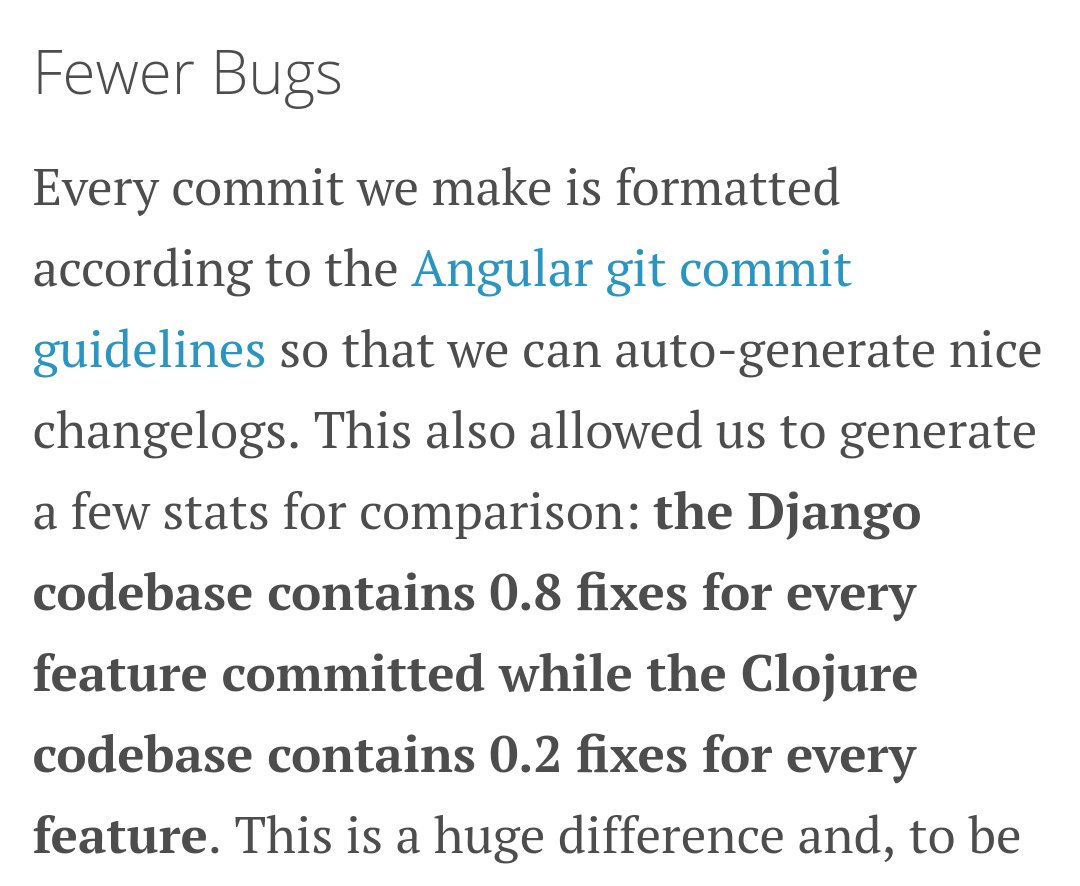
The benefit of annotating commits by feature: you can measure how many bugfixes each feature needed!
The Case for Clojure and GraphQL: Replacing Django
There are a few GraphQL options in Clojure and, after testing the popular libraries, one came out way ahead of the others: Lacinia.
X / ?
Oct 15, 2017
Racket seems to have a critical mass of mindshare: tons of accomplished lispers building some amazing PL features. I need to use it more.
Oct 15, 2017
Is 'make -jN' an anachronism? Shouldn't a modern build tool choose a sensible level of parallelism without human intervention?
Oct 15, 2017
"a lock-free application won’t lock up even with thread scheduling decisions being made by your worst enemy"
https://morestina.net/blog/749/exploring-lock-free-rust-2-atomics
Oct 14, 2017
Creating a circular data structure should be impossible with immutability, right? Amazingly, laziness enables this:
Tying the Knot - HaskellWiki
Oct 14, 2017
We're discussing a logo for Remacs!
https://github.com/Wilfred/remacs/pull/360
Oct 13, 2017
Too many program synthesis tools assume your spec is in a decidable format. They've had incredible results, but tests are way more general.
Oct 13, 2017
It's less interesting to argue in favour of a type system in general. Should it be gradual, structural, nominal and/or dependent, and why?
1
...
8
9
10
11
12
...
59
Showing 136-150 of 885 posts