"The phrase the Rust team members like to use is that they’re trying to make the best 90’s era programming language they can."
Thoughtful comparison between Rust and Haskell.
https://www.fpcomplete.com/blog/2018/11/haskell-and-rust
miniblog.
Rust's model of async-await is really interesting. They chose a suffix syntax (`foo.await` instead of `await foo`) because it composes better!
The evaluation model is also lazy: creating a future does nothing until it's awaited.
Sentry is moving to license that prevents others from offering paid services.
It's stricter than AGPL, which allows others to host if they share source. It's really interesting to see a license that becomes more open after a certain period!
https://blog.sentry.io/2019/11/06/relicensing-sentry
In 24 years of Perl on CPAN, you can see a clear trend to spaces over tabs!
From https://squareperl.com/en/tabs-vs-spaces-in-millions-of-perl-files
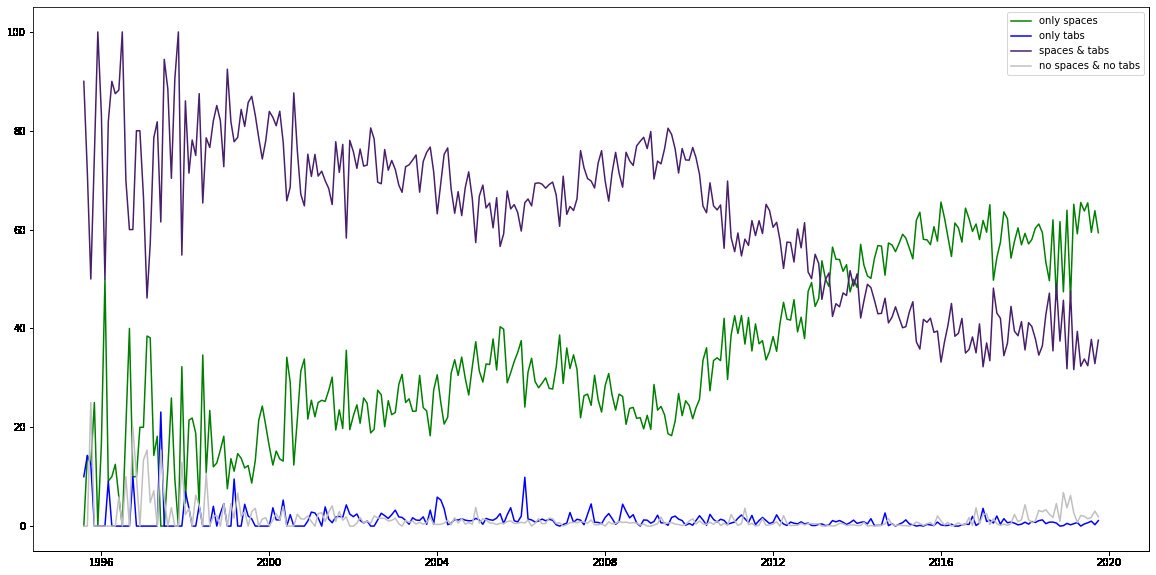
In 24 years of Perl on CPAN, you can see a clear trend to spaces over tabs!
From
Reading the future with Emacs, or why M-n is useful in the minibuffer:
https://engineering.collbox.co/post/working-faster-in-emacs-by-reading-the-future/
(An excellent Emacs tip, which works in deadgrep too!)
The RustSec database is organised and thorough. It's much harder to have memory vulnerabilities in Rust, but they do happen!
Wonderful Strange Loop talk demonstrating Comby, a very simple parser with an elegant pattern language for large scale refactoring.
https://youtu.be/JMZLBB_BFNg
@amiloradovsky@functional.cafe If he hadn't understood my shortened version, I'd have ended up saying that :)
Wonderful Strange Loop talk demonstrating Comby, a very simple parser with an elegant pattern language for large scale refactoring.
https://youtu.be/JMZLBB_BFNg
Thoughtful article exploring upfront design versus evolutionary design, and contrasting with Worse Is Better.
The comments on the post is an impressive set of tech people too.
I sometimes have problems with technology terms or acronyms that I've only seen written and don't know how to pronounce.
For example, I recently chatted with a Scheme user about R^5RS. Fortunately he understood "R5"!
Python has always been a batteries included language, but some modules support obsolete 80s tech! There's now serious discussion of removing them:

Cute usage of chpwd() in bash to convert directories into a simple text adventure game: https://belkadan.com/blog/2019/08/go-east/
Showing 1,831-1,845 of 7,653 posts