A metacircular interpreter in Prolog: https://www.metalevel.at/acomip/
The fact that this exists at all is mindbending to me. It's easy to just see Prolog as a logical reasoning engine.
miniblog.
Archiving Flash content before the plugin dies and the websites disappear forever:
https://blog.usejournal.com/adobe-flashs-gaming-legacy-thousands-upon-thousands-of-titles-and-my-efforts-to-save-it-58c14811558a
(Though there's still a need to preserve content using platforms that aren't about to die, the demise of Flash has spurred this project.)
Scaling OSS projects is hard. Most of my projects get a bug report every few weeks, which is very doable.
I don't envy the projects that explode in popularity though. You end up with a ton of issues and PRs and risk burnout.
Cincom is handing out licenses for using their Smalltalk implementation for personal use!
I've downloaded it and I'm going to kick the tires 😀
Shower thought: does the concept of subtweeting only work because groups of people tend to cluster around specific interests, so they see the same tweets?
A really fun project: installing uLisp on an Arduino Due, making it talk to a typewriter, and then writing an editor for the setup! https://youtu.be/z-u4kUeIqDI
Emacs core is dropping Misc objects! Everything that isn't a basic type (list, strings, buffer etc) will now be a pseudovector:
An interesting paper looking at bugs in the Linux kernel and exploring which wouldn't work on seL4: https://ts.data61.csiro.au/publications/csiro_full_text/Biggs_LH_18.pdf
(Also, apparently Google's Fuschia is based on the Zircon microkernel!)
rustfmt is nearing a 1.0 release with a stability guarantee for frozen formatting! https://twitter.com/nick_r_cameron/status/1029498333750935552
Using multiple keyboards so you can have *even more* keybindings in Emacs! https://jordekang.tk/posts/rus-kbd.html
Myroslava is doing some exciting work on code completion in Pharo:
https://medium.com/@myroslavarm/my-internship-at-inria-one-month-in-e43971d95fba
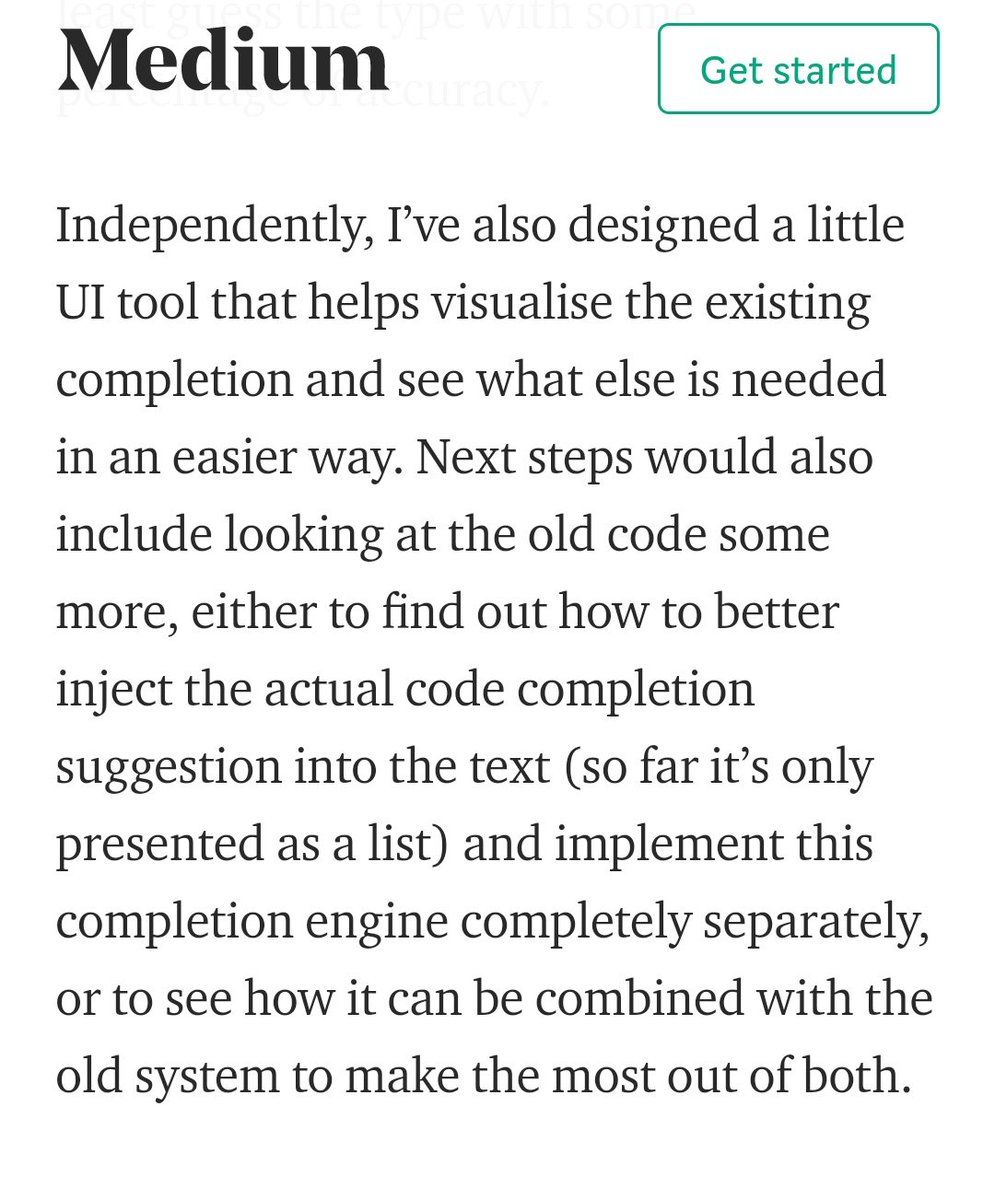
However, this paragraph particularly jumped out at me. This is classic Smalltalk: building a little helper GUI specific to your task!
.@melpa_emacs has a new, great looking logo! https://github.com/melpa/melpa/issues/5452
@wasamasa@niu.moe I suppose it makes some usages easier and others harder.
jQuery.each supports early termination, whereas Array.prototype.forEach does not. In Smalltalk this is less necessary.
Stack Overflow is prototyping a new Create Question UI: https://meta.stackoverflow.com/questions/369682/ask-a-question-wizard-prototype
This is so important for guiding new users and setting expectations. I'm optimistic it will improve the site.

Another interesting post where PVS-Studio explores running their tool on a major open source project, this time Android.
https://www.viva64.com/en/b/0579/
It seems like a number of these checks would be straightforward additions to OSS compilers.

Showing 2,716-2,730 of 7,653 posts