Docstrings are an awesome features that make languages more ergonomic. They help you understand code on the first read, and there's pressure to write them when it's part of the language.
I suspect you can even get away with awful syntax if docstrings are ubiquitous.
miniblog.
Emacs is still becoming *more* customisable over time! For example, in 2016, the backtrace function became a user-level function. https://git.savannah.gnu.org/cgit/emacs.git/commit/?id=27cada035a79b633e856a437dd0e037acc1d61c6
This allows users to introspect, debug or write their own!
Remacs is very much taking GNU Emacs compatibility seriously! When code gets ported, the comments come too :)
From https://github.com/Wilfred/remacs/pull/817 and



TIL about Montgomery Emacs, an early implementation that ran on PDP-11 Unix: https://www.softwarepreservation.org/projects/emacs
Seems like there was quite a convention of naming implementations after the author!
@aidalgol@icosahedron.website Briefly, I think. I certainly read breathless articles that believed core counts would be much higher by 2018!
You can a design a new PL so it's easy to write for humans and analyse by a computer.
Alternatively, if you can win the popularity contest, the tooling will emerge anyway! This makes it hard for new PLs to leverage their advantage.
(C.f. parsing C++.)
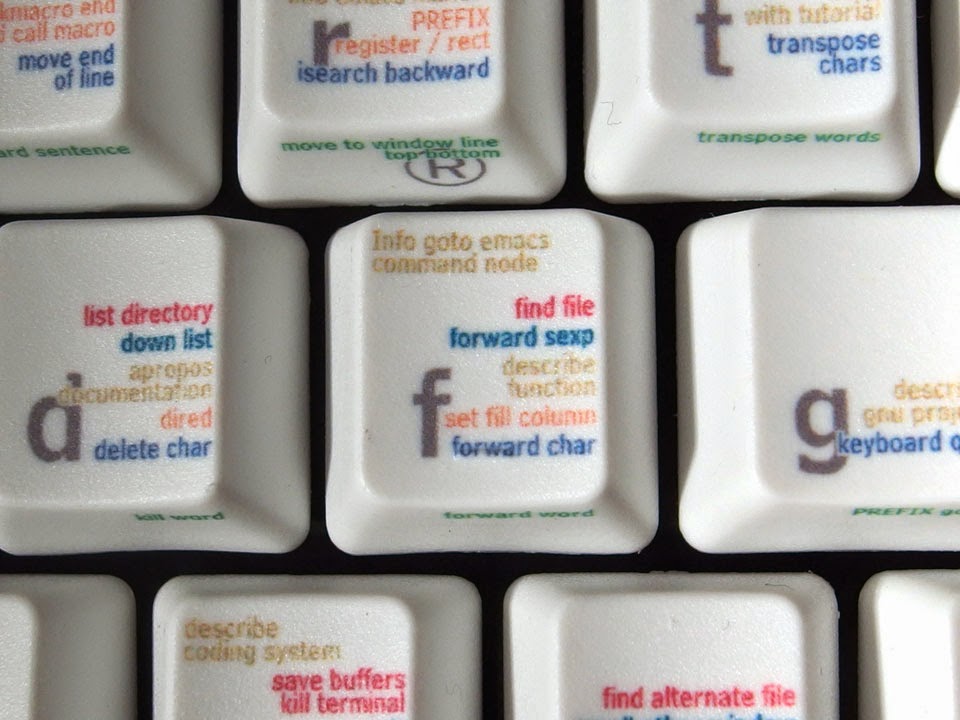
There exist keyboards specifically designed for Emacs! https://keycapdiy.blogspot.com/2014/10/emacs-keyboard.html
(Tricky if you rebind keys though!)
@sillystring@infosec.exchange Agreed! I suspect the high price is partly to prevent excessive gTLD creation, but it probably increases the likelihood that more will be abandoned too.
@cstanhope Git doesn't strictly require branches, but it's rare to create commits on top of a detached head. I also believe there's no way to push commits that aren't associated with a branch or tag.
CPU clock speed, FLOPS, number of cores, die shrinking: progress in all these areas is now much slower.
What areas of tech are still exponential?
Some clever performance techniques for Emacs startup are discussed in the doom-emacs readme:
"We’ve told stories about inanimate things coming to life for thousands of years, and these narratives influence how we interpret what is going on now"
On AI coverage in the press: https://www.theguardian.com/technology/2018/jul/25/ai-artificial-intelligence-social-media-bots-wrong
Showing 2,746-2,760 of 7,653 posts