Interesting short article arguing that software cannot (or should not) iterate on features faster than users can adapt:
miniblog.
Cute example of configuring Emacs to avoid GC when the minibuffer is open (so completion is quick):

seL4, the verified microkernel, jas been ported to RISC-V!
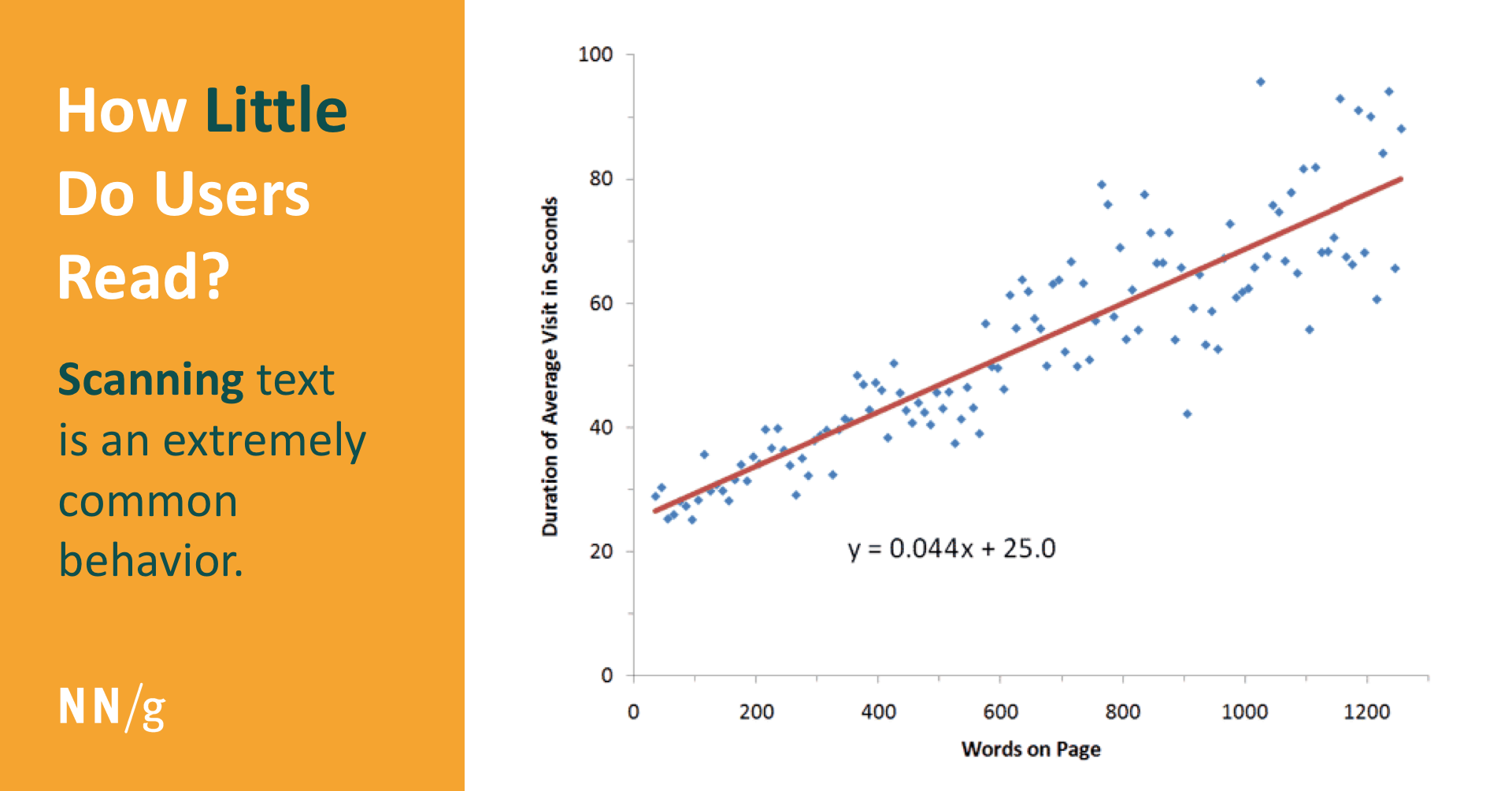
How much do users read on web pages, and how does it scale with word count? https://www.nngroup.com/articles/how-little-do-users-read/
(It's only around 20%, and you're better off keeping your content short!)
Cute idea (in a rather dramatic blog post): randomly generate strings for PL keywords, and apply the same transformation to your source code.
This prevents code injection: https://blog.polyverse.io/introducing-polyscripting-the-beginning-of-the-end-of-code-injection-fe0c99d6f199
(I suppose you could brute force, and they don't say if it breaks eval.)
Fun post on team structure, mental models, shared learning and the transformative impact of software tools: https://the-composition.com/the-origins-of-opera-and-the-future-of-programming-bcdaf8fbe960
"Over the years Alice and Bob have tried to defraud insurance companies, played poker for high stakes by mail, and exchanged secret messages over tapped telephones. ... This may be the first time a definitive biography of Alice and Bob has been given."
Shipping a generic NES emulator inside a GameCube game!

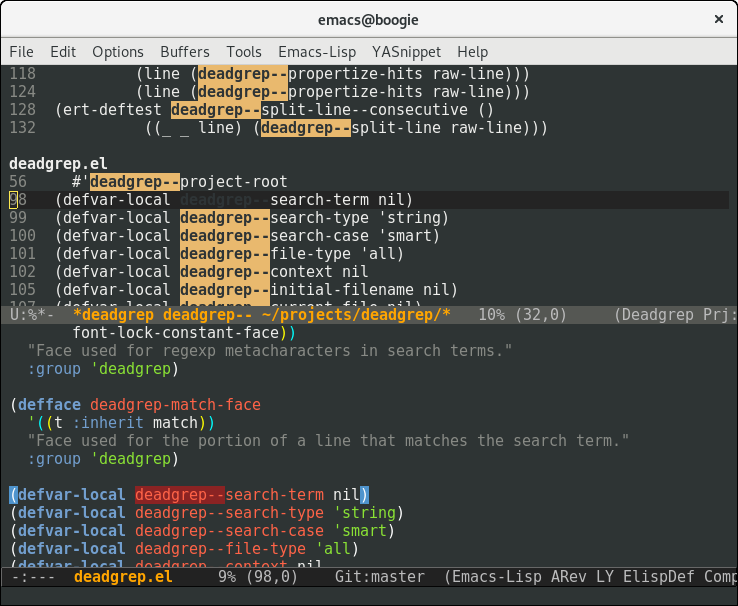
I've added a neat little feature to deadgrep: when you navigate to a line, the matched part of the line is highlighted! See the bottom half of my screenshot.
This was inspired by the excellent roadmap in helm-rg!
The remarkable lengths that Google goes to in order associate items with search terms:
Profiling symbolic execution by measuring the symbolic heap and the symbolic execution graph to ensure solver-aided tools are performant: https://2018.splashcon.org/event/splash-2018-oopsla-finding-code-that-explodes-under-symbolic-evaluation
(Part of the remarkable Rosette project.)
Firefox is now compiling with Clang on all platforms! A major milestone.
@uranther@cybre.space I believe Stylish has now been pulled from both Mozilla and Google's extension websites.
https://stevelosh.com/blog/2018/07/fun-with-macros-if-let/ is an excellent post on implementing if-let and when-let macros.
It discusses the different ways you could expand the code, and ensuring the macro composes with other (Common) Lisp features.
Really useful macro too, I'm a big fan of the elisp equivalent.
Showing 2,776-2,790 of 7,653 posts