TIL an obscure git flag: --intent-to-add. Adds an empty file at a given path, so you can see new files as diffs:
miniblog.

Utter Disregard for Git Commit History https://zachholman.com/posts/git-commit-history/ (the unit of change is important -- put PR descriptions in merge commits?)

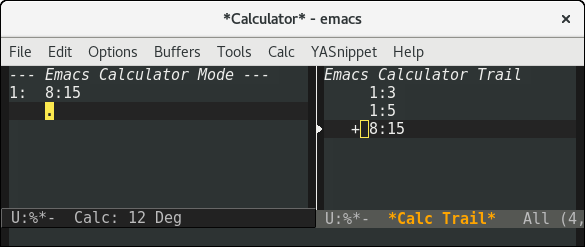
Did you know that M-x calc in Emacs supports exact fractions? (I didn't.) Use colons, so 1:3 is one third.
Imagine calling a method on all your superclasses and summing: https://www.gigamonkeys.com/book/object-reorientation-generic-functions.html (method-combination: CLOS is amazingly flexible!)
Buggy C++ (including use of == in place of =) enabled an attacker to create Zcoin from thin air: https://makebitcoingreatagain.wordpress.com/2017/02/18/is-the-zcoin-bug-in-checktransaction/ (formal methods?)
Golang community survey: https://blog.golang.org/survey2016-results (a much underrated way of finding ways of making PLs better)
Crystal clear intro to the challenges of inlining with good debug info https://docs.google.com/presentation/d/1Wcblp3jpfeKwA0Y4FOmj63PW52M_qmNqlQkNaLj0P5o/edit#slide=id.p (even though Go lets you inspect the stack!)

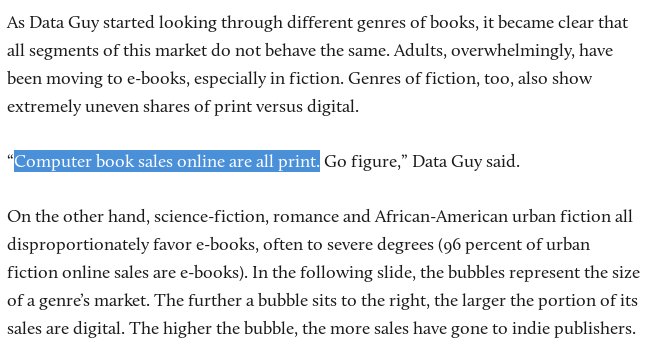
Amusingly, *technology* book sales still prefer paper over ebooks!
If you've ever fancied implementing a type checker, there's a fun example in readable JS here: https://languagengine.co/blog/so-you-want-to-write-a-type-checker/
JIT compiling elisp: https://nullprogram.com/blog/2016/12/11/ (really nice demonstration of the power of lisp)
To my surprise, mapcar is so fast (it's an elisp primitive) that creating lambdas is cheaper than using a loop:
Intriguingly, Haskell has *three* exponentiation operators to ensure everything is type safe:
Let’s stop copying C https://eev.ee/blog/2016/12/01/lets-stop-copying-c/ (excellent overview of C's quirks and how it has influenced later languages)
I have graciously been given access to @ecotd, so do follow that account to learn new Emacs commands! (cl-incf productivity)
Showing 3,856-3,870 of 7,654 posts