Archy was an amazing UI with persistence, modeless ZUI and an Emacs influence! https://en.wikipedia.org/wiki/Archy Why hadn't I seen this before?
miniblog.
Conventional OOP does type dispatch on the first argument, so foo.<TAB> in IDEs is helpful. Statically typed functions could do the same!
Zero-cost futures in Rust: https://aturon.github.io/blog/2016/08/11/futures/ (the scope for building efficient, elegant APIs across the whole ecosystem is exciting!)
eslint --fix, babel, lebab, uglifyjs and rollup: I'm extremely impressed with the versatility of the AST transformation ecosystem in JS!
Quite a few Emacsers live on the edge. From time to time, I stumble across code that only works on Emacs 25!
The #emacs channel on Freenode is an absolute goldmine of information. They're a great place to ask questions when you're stuck.
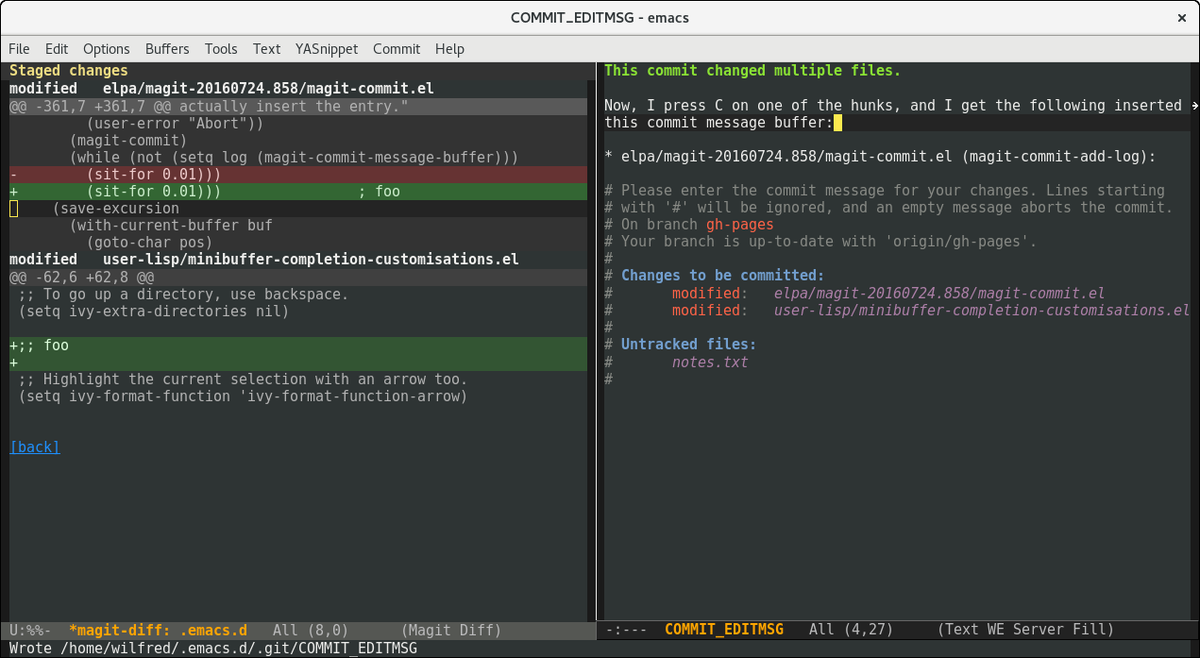
Want to highlight specific files you've changed in your commit? magit-commit-add-log (press `C') adds paths for you!
TIL in Emacs, pressing TAB in a *Help* buffer lets you jump straight to the links. Saves me ~5 keystrokes!
Historical defsubst macrology by jwz before the elisp byte compiler: https://web.mit.edu/~deberg/emacs/elisp/defsubst.el (cf #define in C!)
Lispers have an embarrassment of riches with control structures. The question is not 'can I express it this way?' but 'should I?'.
Lisp is the jazz of programming languages.
Trying to optimise some CPU-bound elisp. Favouring C built-ins makes a big difference! Next, I'm going to try byte-compiling and defsubst.
TIL Eli Zaretskii, the Emacs co-maintainer, is also a Guile contributor! https://git.savannah.gnu.org/cgit/guile.git/log/ Perhaps Guile Emacs will happen?
Showing 4,366-4,380 of 7,654 posts