Tests may not guarantee correctness, but they are often suggestive.
When I have a bunch of regression tests for *real* issues, I feel a lot more confident. I'm covering ways I've failed in the past.
miniblog.
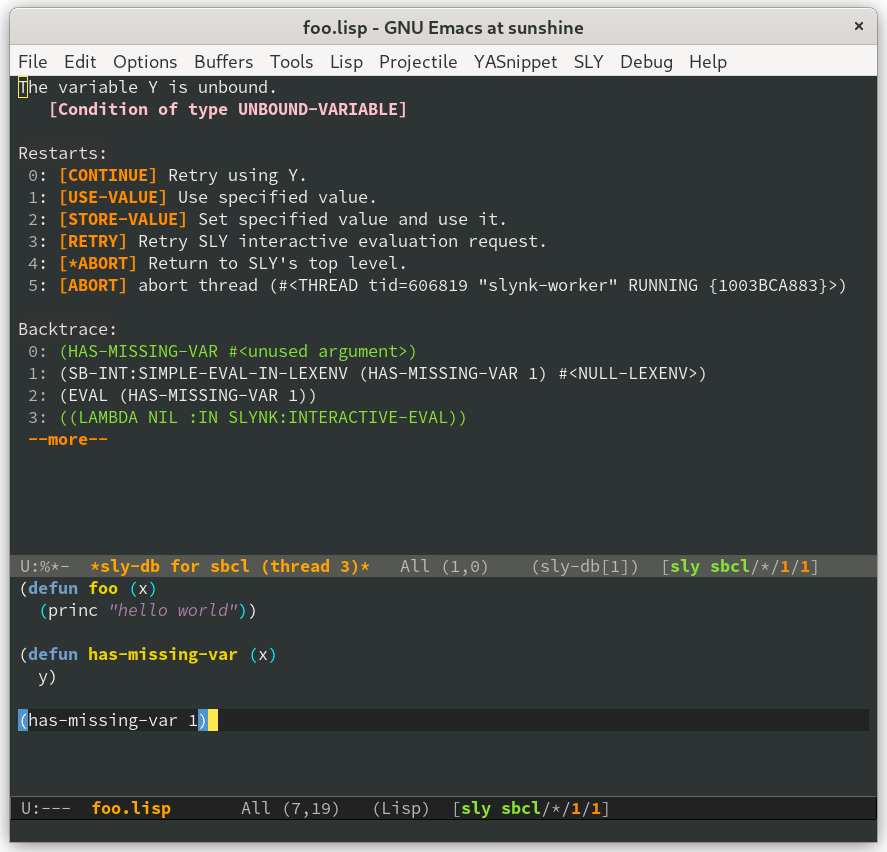
I'm impressed by how many options I'm offered in Common Lisp (in this case sbcl on Sly) for a simple error like an invalid variable name!
I'm curious to try bluesky: anyone tried it?
I still find it odd that non-OO languages use the term "object" in their docs. I've seen it in both C and Emacs Lisp.
Example:
Are there any languages that have both pattern matching and statement oriented syntax?
In principle these are orthogonal, but I'm struggling to think of a language with pattern matching that isn't expression oriented.
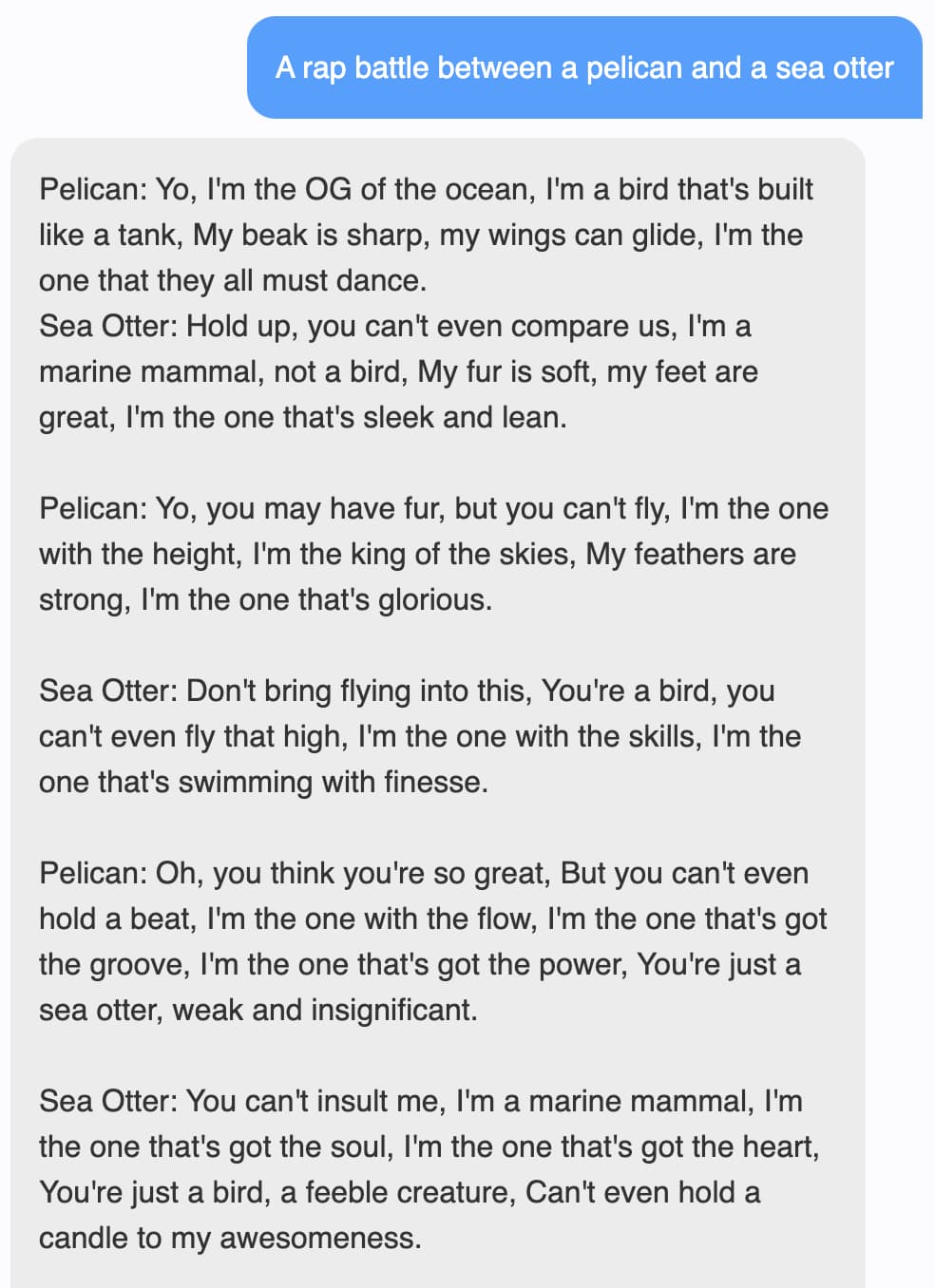
I'm super impressed that LLMs are scaling down and WebGPU is improving to the point that you can run a reasonable LLM in the browser!
In Python I can choose any name for my instance variable when defining a method. In practice people almost always use `self`.
Go has the same flexibility, but using other names for the instance is totally normal!
Every time I implement an interpreter with recursion, I regret it.
As soon as I want TCO, or userland control of stack limits, or resumable exceptions, I need my own stack.
This is awkward because it's an upfront design decision. Changing the stack model is a big refactoring.
Which programming languages follow the "cathedral" design philosophy, where they provide most of: the runtime, stdlib, debugger, LSP, test harness, code formatter and package manager?
Go, Dart and Smalltalk are the closest I can think of.
Having a conversation with a PDF is a really fun application of LLM technology: https://www.chatpdf.com/
I enjoyed this interview with Lukas Wirth, one of the maintainers of rust-analyzer: https://rustacean-station.org/episode/lukas-wirth/
I didn't realise how little code was shared between rustc and rust-analyzer (only lexing and type layouts). This makes it hard to track new Rust features.
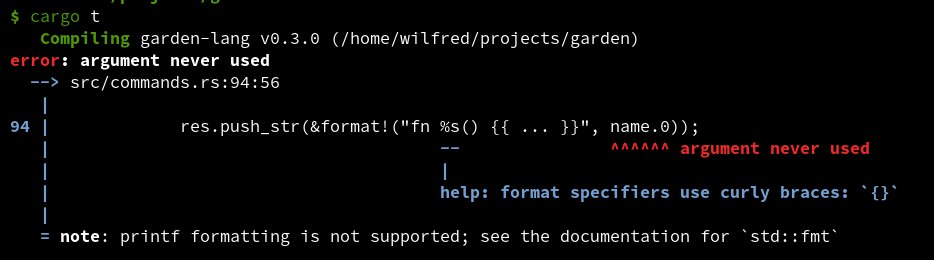
I'm really impressed with this Rust error message: if you write %s instead of {} in your format string, it helpfully tells you that your syntax is wrong!
I'm a huge fan of languages that require you to explicitly export your functions (e.g. pub in Rust or export in JS).
It's much easier to change than a separate header file (.h in C, .mli in OCaml) and it enables local reasoning. You can see from the definition if it's exported.
Thoughtful article about building older software with Nix: https://blinry.org/nix-time-travel/
It's striking how a project that does so much excellent work on build reproducibility still has some build errors in this scenario. Bitrot is scary.

On teaching Haskell, and which parts of the semantics are tricky for newcomers: https://ciobaca.substack.com/p/pedagogical-downsides-of-haskell
Showing 511-525 of 7,652 posts