Are there any noteworthy lisp dialects that don't have macros?
Macros aren't obligatory, but I'm struggling to think of any good lisp examples that lack them.
miniblog.
Super impressed that the UK government does regular scanning for vulnerabilities for servers based in the UK: https://www.ncsc.gov.uk/information/ncsc-scanning-information
Preventative and good for the overall ecosystem.

A cute project that finds Clojure stdlib functions based on an example input and output: https://borkdude.github.io/re-find.web/?args=2&ret=3
Underrated perk of JSON: it's easy to programmatically make changes to a file made by a human.
Very few other formats have this advantage. `cargo add` took a bunch more implementation work than `npm install`, because preserving TOML comments takes more work.
I write a lot of markdown, so I'm comfortable with the format, but *asterisks* for *italics* still seems strange to me.
I mentally read it as bold, and some mailing list web frontends to the same thing.
@dcreemer@octodon.social I set it up once and I've never needed to fiddle again: it's worked really well.
I also use Tusky on my phone to read toots and respond to folks. I don't want my Mastodon usage to be write only.
Applying different profile guided optimisation techniques to the rust compiler:
Efficiently sandboxing Firefox by compiling potentially vulnerable libraries to wasm, and then compiling wasm to C!
On the remarkable inertia of database and programming language choices early in the life of a company:
I get a lot of value from tech/PL microblogging as @_wilfredh on Twitter, and often get interesting comments. I'm not sure how much the new CEO will affect that.
I also cross-post to https://mastodon.social/@wilfredh and have interesting discussions there too. Both are worthwhile today.
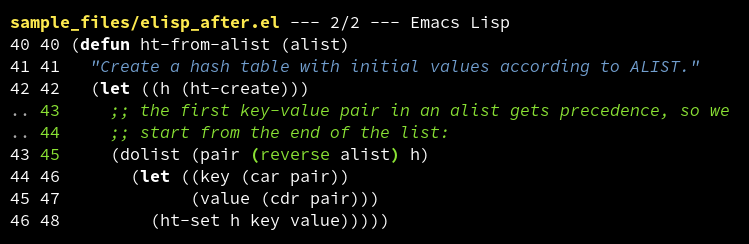
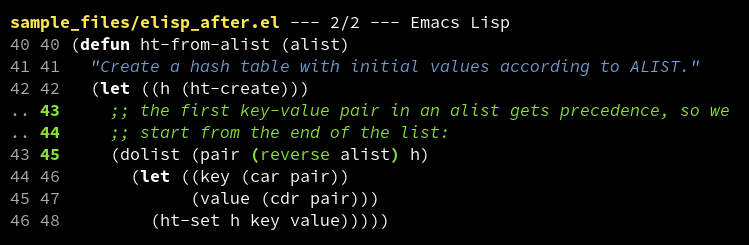
I'm experimenting with line number styling in difftastic. The first screenshot is the old version, and the second screenshot shows the new.
I want line numbers to be visually distinct from content. The new version is using dim text for unchanged lines, and bold otherwise.
Experience report on writing the same small web app in C#, Deno, Go, Elixir, Rust and Scala:
Contrasting a Rust specification (being worked on) with a Rust ISO standard (which may not work as well as the existing RFC process), and backward compatibility promises: https://blog.m-ou.se/rust-standard/
(The entire Rust ecosystem is run against new rustc versions surprisingly often too)
A live demo of how you edit BASIC code (its REPL equivalent) inside a thoughtful article on how we interact with programming languages:

RISC features for ISAs, and which design choices have stood the test of time: https://wiki.alopex.li/RiscIn2022
Showing 706-720 of 7,652 posts