The internet is an incredibly hostile place for unpatched devices. I'd be nervous about booting any older operating system in a VM and getting online.
Maybe there's a sufficient age where it's safe again? I'm not sure if an MS-DOS VM would get automatically pwned today.
miniblog.
One thing that bothers me about today's diffs: we often read changes in a format that patch can consume!
Diffs are largely read by humans, but we have to mentally parse "@@ -40,7 +40,9 @@". Which line is line 40? Is it the first visible line, or the first changed line?
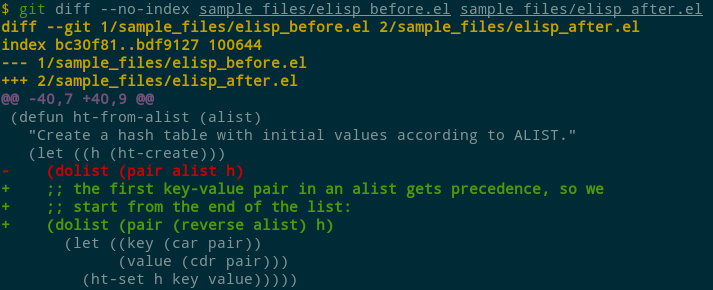
My syntactic diff tool basically works!
Diffing trees and printing them in a comprehensible way is extremely tricky. I'm hoping to get something I can release once I've hammered out the bugs.
WIP code is at

Building a performant IDE that scales is a non-trivial architectural problem: https://news.ycombinator.com/item?id=27428625
Sometimes a typechecker spots a ton of issues. I find that lists of numbers get very little benefit though.
I'm writing some messy logic that groups line numbers, and it's super easy to screw up.
Are there other cases? Strings might be another example.
Which Rust libraries are the most "business-y"? A fun analysis that compares weekday download rates with weekend downloads: https://old.reddit.com/r/rust/comments/nsvyxq/what_are_the_most_professional_crates/
checked_int_cast is used more on weekdays, whereas cpp_syn is used more at weekends. Not sure what to conclude there.
TIL that Python allows you to override subclass logic with __subclasshook__! This lets you define protocols, or cute things like isinstance(Noon(), PalindromicName).
Python goes all-in on metaobject protocols :)
https://www.hillelwayne.com/negatypes/
(1) Stare at code wondering what my new struct should look like.
(2) Make coffee and realise what fields I need.
(3) Type it out.
Which of these count as programming? (3) looks like it, but doesn't feel like it.
I've been playing with Hammerspoon to speed up my workflow on macOS.
Setting up shortcuts to jump to my most used apps is really nice. Alt-Tab forces me to choose from a large list.
GQless takes an elegant approach of deriving GraphQL queries directly from your controllers. You write code in typescript (tab-completed etc), and it generates queries!
Reading about Oberon on RISC-V, and I'm surprised to learn that adding a USB stack would probably be a major increase in total lines of code! https://news.ycombinator.com/item?id=25501944
GCC will no longer require copyright assignment to the FSF! https://lwn.net/Articles/857791/
It's definitely a hurdle (I've done the paperwork in several jobs) so this should really help new/casual contributors.
cargo flamegraph is a delightful way to run your Rust binaries as normal, but see a flamegraph of runtime performance! https://github.com/flamegraph-rs/flamegraph
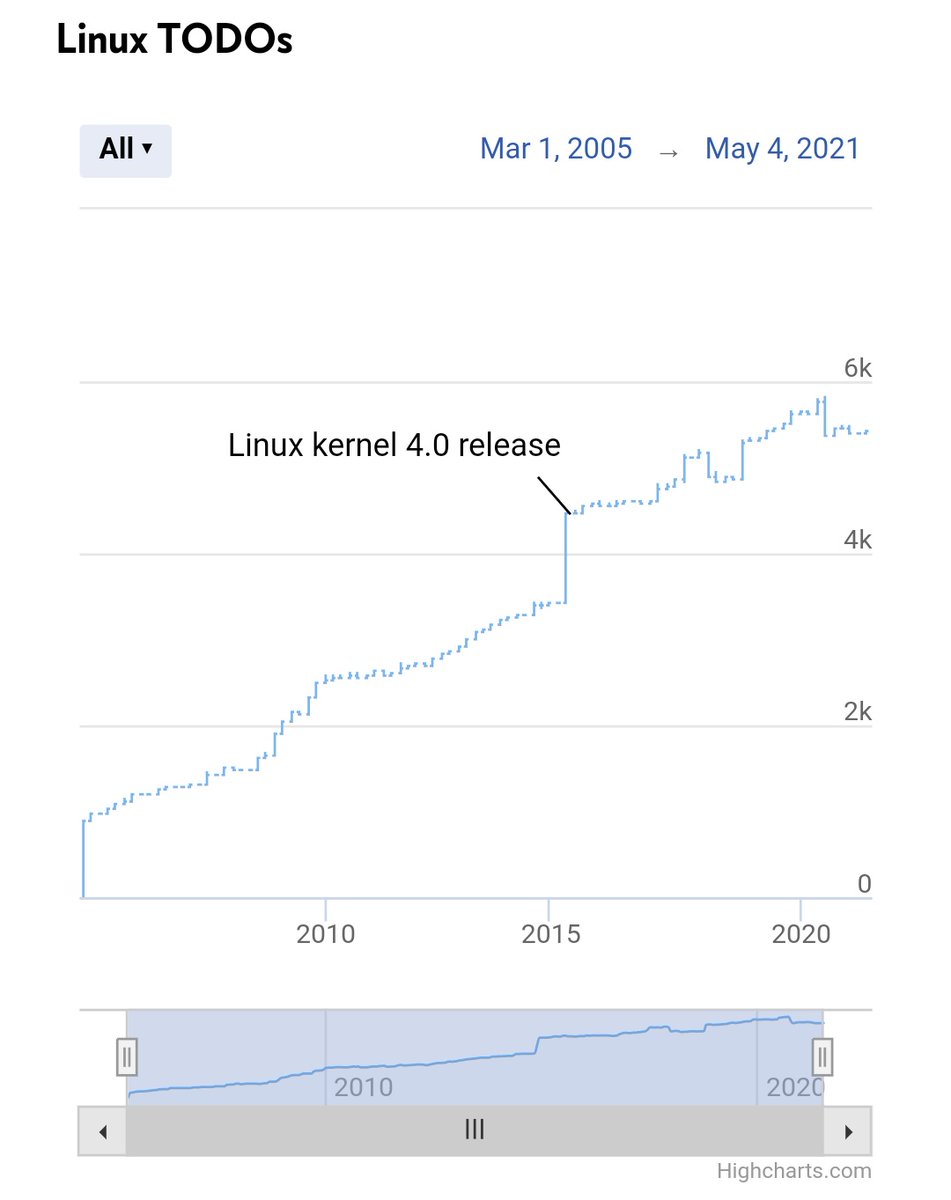
Plotting TODOs over time for different OSS projects is a really interesting way to look at project development: https://schleiss.io/plotting-source-code-todos-for-open-source-projects
There's often a bump before a major release. Most projects increase over time (perhaps it's proportional to LOC?).
scc is a fast, polished tool for counting lines of code: https://github.com/boyter/scc
The author has several great posts discussing LOC tooling, including this one on exploring codebases with it:
Showing 1,216-1,230 of 7,652 posts