grex is a really impressive tool that generates a small regex for a given set of string inputs: https://github.com/pemistahl/grex#53--examples-top-
There's a live instance you can play with at:
miniblog.
Fascinated (and slightly surprised) that Google found ~50% of security bugs occur in code written in the last 12 months.
So maintained code that isn't actively developed is often good!
2
Super impressed that I received an elisp PR that discusses backwards compatibility to 1997!
One nice property of autoformatters: they're a really fast way to do a quick syntax check. Especially with a slow build process, it's a good check for dumb mistakes.
8
It's now possible to compile small Rust programs with libgccjit! This will enable Rust on a bunch more architectures.
https://blog.antoyo.xyz/rustc_codegen_gcc-run-core-tests
Admittedly these programs don't run correctly yet, but getting something basic working often takes 80% of the work in PL.
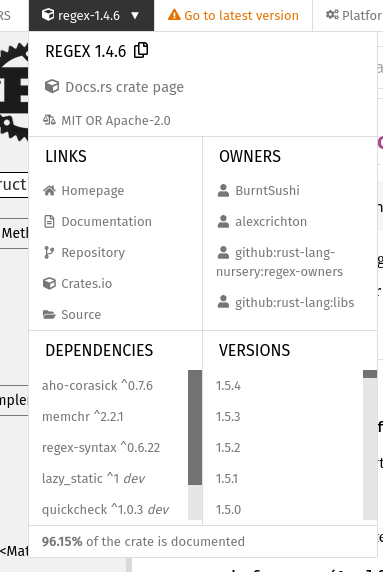
The Rust documentation host, https://docs.rs/, has a really cute nudge to make sure your code has documentation. It exposes the docs coverage percentage in the UI!
Blog comments work best when the author has a large following, and they actively engage their community.
I don't think many blogs reach this scale. For a typical blog, it's probably better to have comments on link aggregators (Reddit etc) instead.
1
I'm coming to the view that NP-complete problems are harder to work with than tasks equivalent to the halting problem.
For the halting problem, you know you're never going to solve the general case. For NP-complete problems there's a slew of complex algorithms to explore.
21
The Nintendo Switch has a clever way of preventing firmware downgrades: upgrading the firmware blows an internal fuse!
https://news.ycombinator.com/item?id=27202766
This means that the hardware knows a newer firmware exists.
1
Writing a REPL that evaluates-as-you-type, keeping the UI responsive and staying defensive against runaway memory usage: https://scattered-thoughts.net/writing/making-live-repls-behave/
It's a really hard problem for PLs, but even this small live demo has a lot of complexity.
3
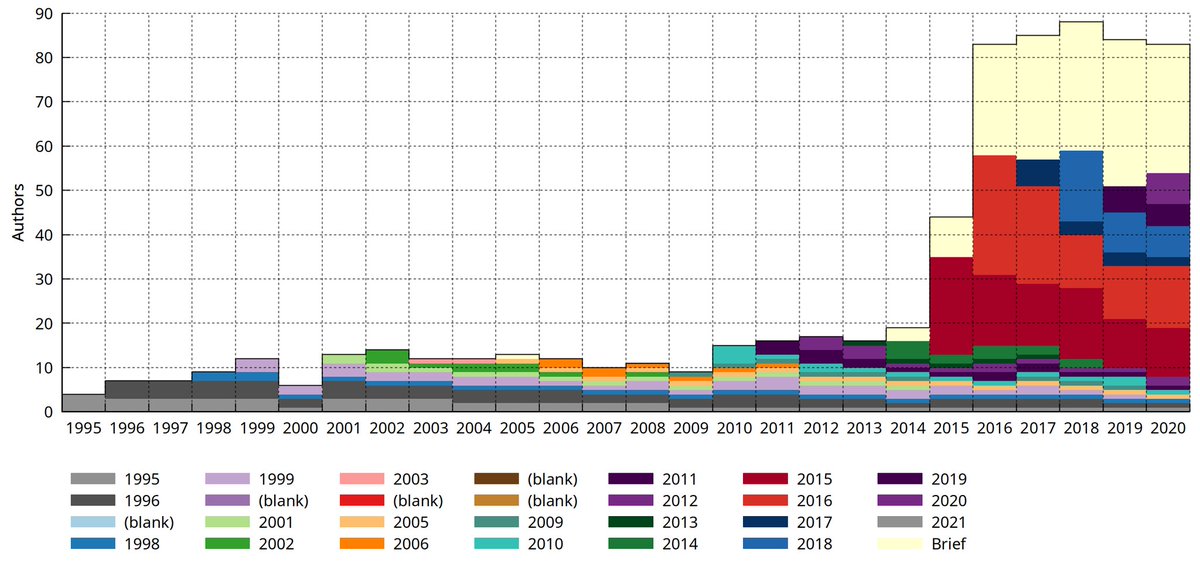
The OCaml compiler saw a huge jump in contributors after moving to GitHub, and the effect has persisted.
Source:

256
This is really neat: an online collection of programs that can pass the type checker but fail at runtime, in a bunch of languages (Java, Scala, OCaml, Haskell, Rust): https://counterexamples.org/runtime-misinformation.html
It also discusses the design tradeoffs that led to these behaviours.
You can go so far with simple data in Rust that it's kinda surprising when you start learning about interior mutability: https://doc.rust-lang.org/std/cell/index.html
If you give a function a value of &T, they can actually mutate any cells within it. It's not sufficient to look for &mut T usages.
2
I keep forgetting how powerful phones are: here's a demo of using external peripherals and developing applications on the device itself!
https://puri.sm/posts/the-simplicity-of-making-librem-5-apps/
Showing 1,231-1,245 of 7,652 posts