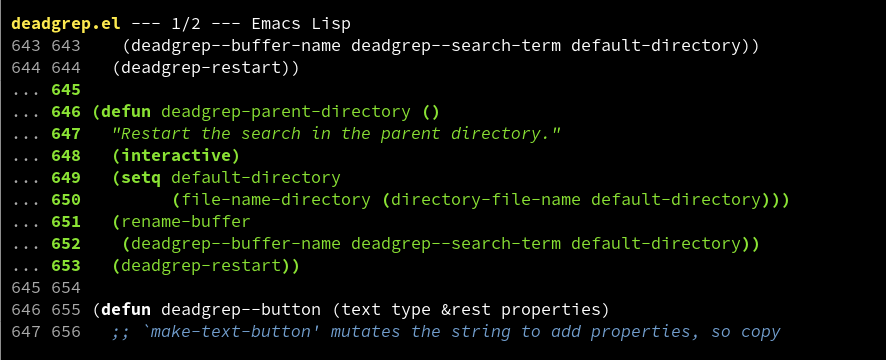
I've been thinking about making difftastic smarter about context. In principle it understands structure, so I could limit context to the enclosing definition.
However, sometimes it's nice to see surrounding code. Line 644 isn't useful, but maybe 655 is. Opinions?
miniblog.
Related Posts
I'm trying to improve the readability of the --help output from difftastic.
I'm experimenting with making example invocations bold, so they are easier to distinguish from the text.
I'm also trying OSC 8 to make my URLs clickable.
Opinions welcome :)
I'm not sure if I should use the term "text diff" or "textual diff" to refer to a conventional, line-oriented diff of text in difftastic.
Any opinions? Which seems clearer to you?
I'm trying to decide the best voice for PL documentation.
Passive: "`let` can be used with destructuring."
Reader focused: "You can use `let` with destructuring."
Describing the PL: "FooLang supports destructuring with `let`."
Anyone have opinions or best practices?