The qualities of great docs: https://blog.stoplight.io/writing-documentation-when-you-arent-a-technical-writer-part-one-ef08a09870d1
(reading patterns, intro text, and effective code samples!)
miniblog.
OCaml map signatures are really weird when coming from a Java/C++ background.
For example, Java's Map<Integer, String> typically becomes string IntMap.
I don't yet have any intuition on the different tradeoffs.
Interesting discussion contrasting OCaml functors with Java interfaces: https://www.reddit.com/r/ocaml/comments/2gjcos/help_explaining_benefits_of_modules_and_functors
You can abstract over more things with functors, and they have some cool examples. Quaternions!
I also learnt that type checking modules is undecidable in general in OCaml.
Cracking the fizzbuzz coding interview with machine learning!
https://joelgrus.com/2016/05/23/fizz-buzz-in-tensorflow/
Comb is an Emacs tool for exploring projects with regexps: https://github.com/cyrus-and/comb/blob/master/README.md
The UI looks very polished!
Joe Duffy's article on error models is a treasure trove of language design insights: https://joeduffyblog.com/2016/02/07/the-error-model/
For example, I was interested to learn that error codes are not the most efficient approach, despite their simplicity.
USB did a fantastic job of standardising cables for devices.
It felt like we were moving away from that (USB B, micro A/B, mini A/B...), but I've come to really like USB C.
It can transfer data, it can charge larger devices, and it *works any way up*!
Fun post on the development of the Sifteo Cube, how to maximise graphics performance on an Arduino-class chip, even building a hypervisor!
Julia has hit v1.0! https://github.com/JuliaLang/julia/releases/tag/v1.0.0
The syntax churn was a little discouraging, so this is a really positive step for the language :)
I Don't Like Notebooks: https://docs.google.com/presentation/d/1n2RlMdmv1p25Xy5thJUhkKGvjtV-dkAIsUXP-AL4ffI/preview?slide=id.g362da58057_0_1
A good discussion of the limitations of Jupyter. It's a challenging design space: you want a helpful code sandbox without reinventing the IDE.
Go 2 will explore generics! https://blog.golang.org/go2draft
The discussion of error handling is interesting too. It proposes adding a 'check' keyword along with a handler that covers any errors in that function. It seems spiritually similar to the defer keyword.
The more I look at Io, the more it seems like f-expressions with an OO flavour. A really interesting mix, although I wonder how hard it would be to write a linter/static analysis tool.
Fabulous introduction to the tooling, mindset, and ecosystem of Common Lisp: https://stevelosh.com/blog/2018/08/a-road-to-common-lisp/
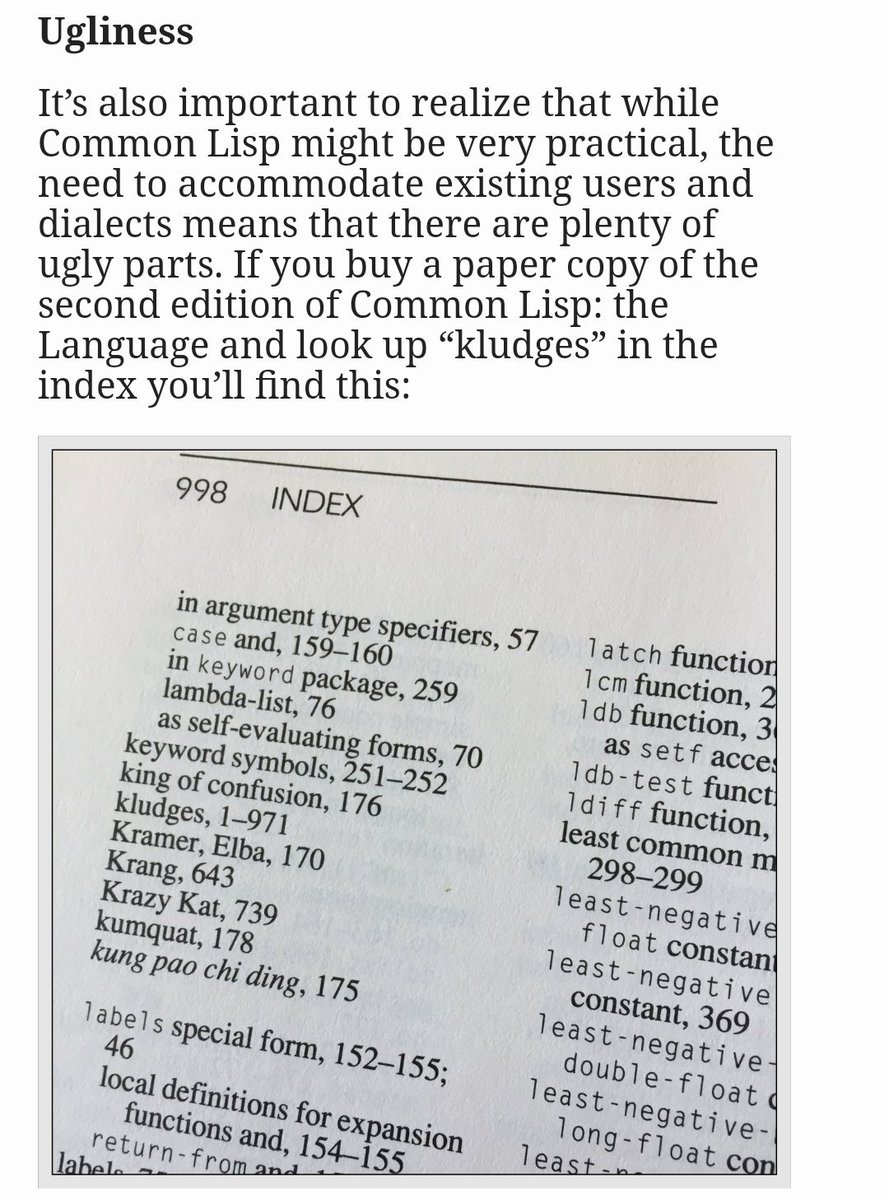
It's also frank about the quirks of the language, which is nice. There's a note on kludges that made me smile.
Showing 196-210 of 657 posts