Cincom is handing out licenses for using their Smalltalk implementation for personal use!
I've downloaded it and I'm going to kick the tires 😀
miniblog.
Shower thought: does the concept of subtweeting only work because groups of people tend to cluster around specific interests, so they see the same tweets?
A really fun project: installing uLisp on an Arduino Due, making it talk to a typewriter, and then writing an editor for the setup! https://youtu.be/z-u4kUeIqDI
Emacs core is dropping Misc objects! Everything that isn't a basic type (list, strings, buffer etc) will now be a pseudovector:
An interesting paper looking at bugs in the Linux kernel and exploring which wouldn't work on seL4: https://ts.data61.csiro.au/publications/csiro_full_text/Biggs_LH_18.pdf
(Also, apparently Google's Fuschia is based on the Zircon microkernel!)
rustfmt is nearing a 1.0 release with a stability guarantee for frozen formatting! https://twitter.com/nick_r_cameron/status/1029498333750935552
Using multiple keyboards so you can have *even more* keybindings in Emacs! https://jordekang.tk/posts/rus-kbd.html
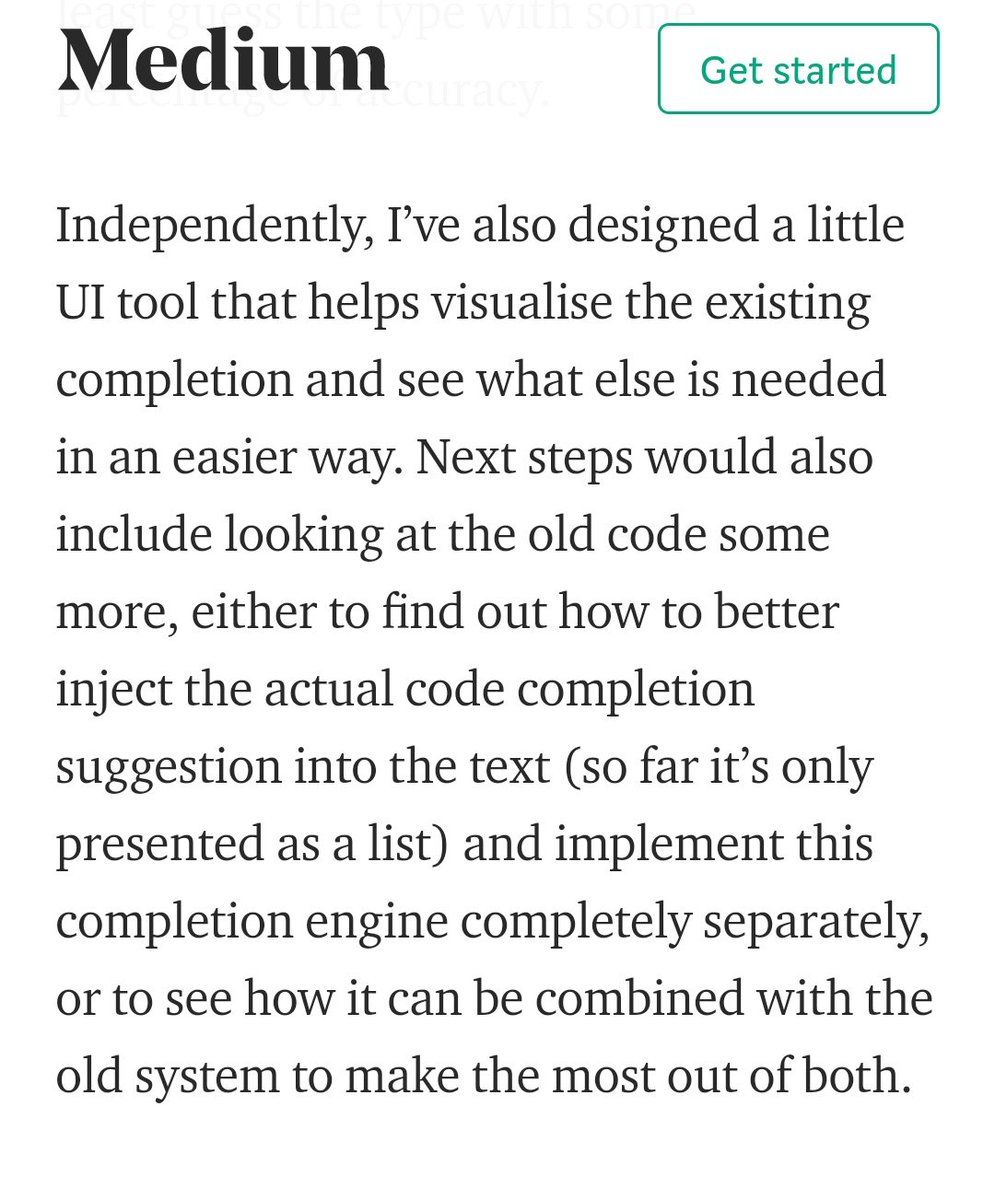
Myroslava is doing some exciting work on code completion in Pharo:
https://medium.com/@myroslavarm/my-internship-at-inria-one-month-in-e43971d95fba
However, this paragraph particularly jumped out at me. This is classic Smalltalk: building a little helper GUI specific to your task!
.@melpa_emacs has a new, great looking logo! https://github.com/melpa/melpa/issues/5452
@wasamasa@niu.moe I suppose it makes some usages easier and others harder.
jQuery.each supports early termination, whereas Array.prototype.forEach does not. In Smalltalk this is less necessary.
Stack Overflow is prototyping a new Create Question UI: https://meta.stackoverflow.com/questions/369682/ask-a-question-wizard-prototype
This is so important for guiding new users and setting expectations. I'm optimistic it will improve the site.

Another interesting post where PVS-Studio explores running their tool on a major open source project, this time Android.
https://www.viva64.com/en/b/0579/
It seems like a number of these checks would be straightforward additions to OSS compilers.

Smalltalk has a concept of blocks, which is a lightweight syntax for anonymous functions.
However, they have this marvellous property: you can return from the enclosing method! This makes them far more useful for things like iterating with early termination.
Autoconf syntax is surprisingly lispy. AC_DEFUN and AC_DEFSUBST seem very similar to lisp's defun and defsubst.
Is is possible to get a tab of just replies on the Mastodon web UI? Interesting responses get mingled with users just boosting content, and it's hard to find replies.
Showing 241-255 of 657 posts