@kensanata@octodon.social @ckeen @JordiGH@mathstodon.xyz For sharing whole packages or writing official docs, I suppose GitHub and a README.md are more common these days.
I do refer to the wiki several times a week for all the additional reference material and advice though :)
miniblog.
Tramp using the new multithreading in Emacs! https://lists.gnu.org/archive/html/emacs-devel/2018-07/msg00862.html
h/t @Koral_001
I was slightly shocked when a Common Lisper first pointed out to me that macros are syntactic. For example, threading macros aren't limited to function composition.
(->> "UTC"
(current-time-string (current-time))
(lambda ()))
This elisp is building a closure!
Today I learnt what specpdl means in Emacs internals!
Special variable PushDown List.
Special variable means a dynamically bound variable, and pushdown list means a stack.
Interesting discussion of inefficiencies in elisp bytecode during function calls: https://www.xemacs.org/Architecting-XEmacs/faster-elisp.html
(From the XEmacs site, but entirely applicable to GNU Emacs and Remacs too I think)
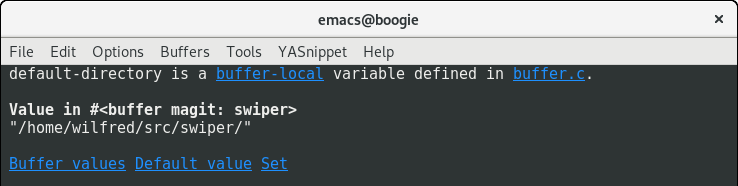
Have you ever wondered which buffers have a buffer-local variable set? It's now possible to view every buffer with an overridden value using helpful.el!
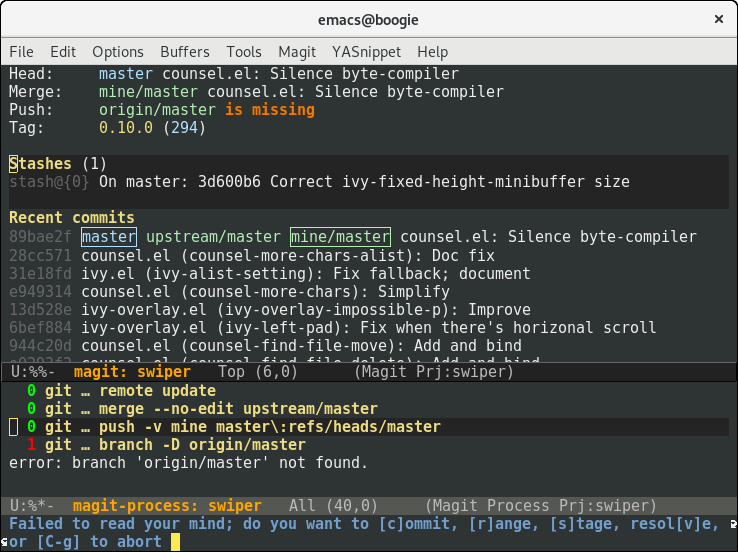
.@magit_emacs has some brilliant error messages. This one made me smile.
Fascinating article on Google's control on Android and how difficult it is to develop and manufacture a device using only the open source parts: https://arstechnica.com/gadgets/2018/07/googles-iron-grip-on-android-controlling-open-source-by-any-means-necessary/
Today I learnt about the redisplay function in Emacs lisp!
This function allows Emacs to redraw the GUI. It's really useful when you're doing computation in a loop, and essential if you're using spinner.el.
Thoughtful article on the industries that Amazon hasn't gained a foothold in: https://www.wired.com/story/the-false-tale-of-amazons-industry-conquering-juggernaut/
(It misses AWS though, and the fact that some competitors run their services on Amazon hardware!)
There seems to be a trend towards value-oriented programming languages. Even established statement-oriented languages are moving: Hack added ==> for values with anonymous functions, JS has fat arrows and now do syntax too.
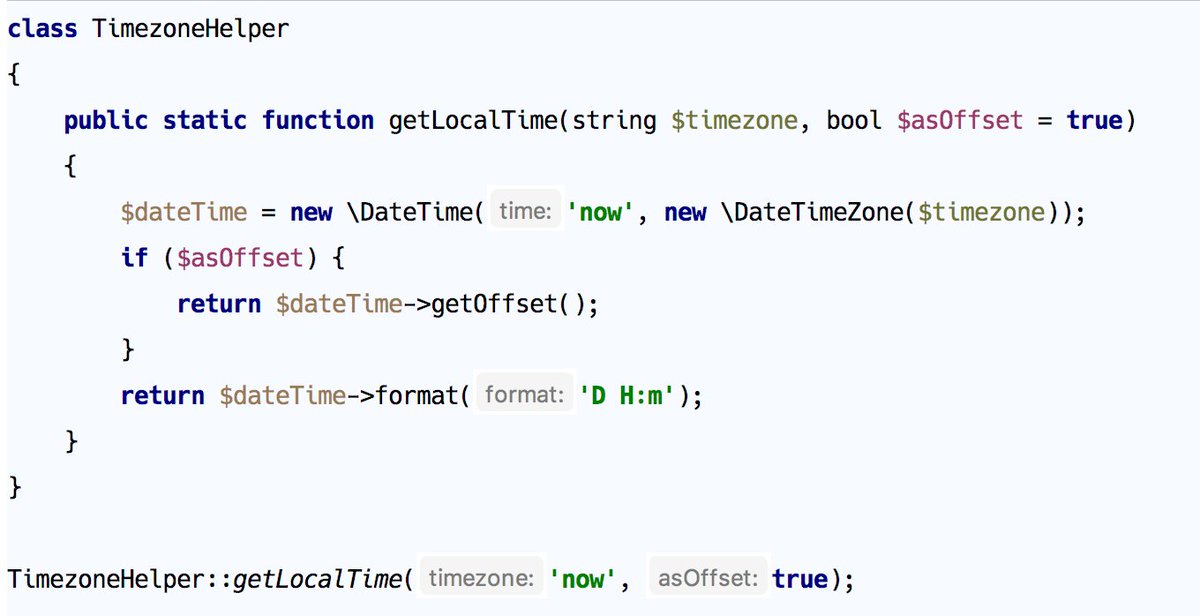
PhpStorm shows annotations on method calls so you can see argument names. https://blog.jetbrains.com/phpstorm/2017/03/new-in-phpstorm-2017-1-parameter-hints/
The heuristic is really interesting: it only shows hints for literals and null! Presumably other values are considered to be more obvious.
Interesting short article arguing that software cannot (or should not) iterate on features faster than users can adapt:
Cute example of configuring Emacs to avoid GC when the minibuffer is open (so completion is quick):

Showing 286-300 of 657 posts