Total Download Size: 3292.10 MiB
Total Installed Size: 13327.24 MiB
Net Upgrade Size: 995.34 MiB
Upgrading a (several months old) Arch Linux box, and you can definitely see that binaries tend to get bigger over time!
miniblog.
Neat debugging feature in Visual Studio for C++: you can use the debugger to only step through code you've written, saving you stepping through layers of the standard library! https://blogs.msdn.microsoft.com/vcblog/2018/06/29/announcing-jmc-stepping-in-visual-studio/
TIL OCaml has .mli files which are much like .h files in C: they define (and enforce) a public interface.
This seems to be less popular in newer languages: we tend to prefer public/private annotations in a single file. I'm not sure why this changed.
Fun article discussing the early development of autocorrect, blacklisting unwanted words and working out what to correct: https://www.wired.com/2014/07/history-of-autocorrect/
(Also contains this remarkable comment: "As someone who typed the entire first draft of his book on a phone...")
Adding dragon emoji as semicolons in node.js or the typescript compiler: https://blog.angularindepth.com/instead-of-semicolons-what-if-you-could-code-with-dragons-df5d0a4ef4ee
Nice post showing that working with programming language implementations need not be scary!
Syntactic Closures by Bawden amd Rees: https://www.dtic.mil/cgi-bin/GetTRDoc?Location=U2&doc=GetTRDoc.pdf&AD=ADA195921
This 1988 paper explores an alternative Scheme macro system before hygienic macros were standardised.
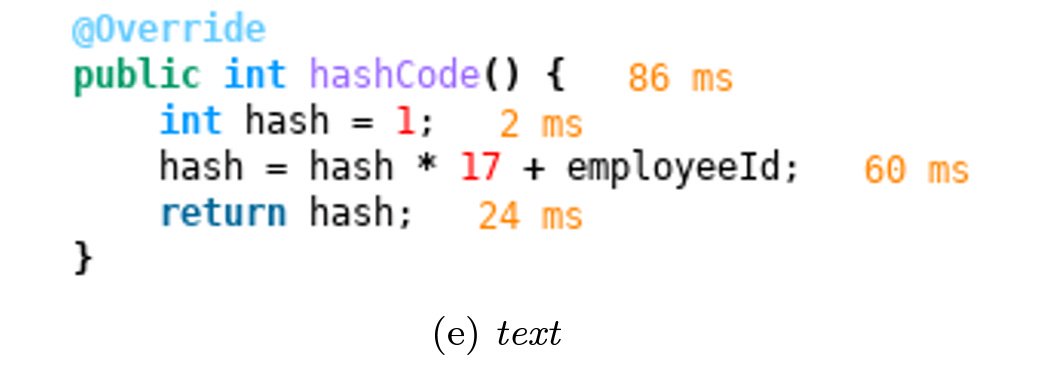
Visual augmentation of source code editors: A systematic review https://arxiv.org/abs/1804.02074
A useful paper categorising all the different ways IDEs can show additional metadata alongside the code.
For example, they show this cute plugin (Clepsydra) that shows worst case runtime.

GitHub has made a considerable effort to let users hide their email addresses: https://help.github.com/articles/about-commit-email-addresses/
I totally understand that users find this desirable, but it's awkward to implement on top of git. GH provide a hook to prevent mistakes: https://help.github.com/articles/blocking-command-line-pushes-that-expose-your-personal-email-address/

A fun quiz on eval() in JS, and corner cases of its behaviour: https://blog.brownplt.org/2012/10/21/js-eval.html
I've seen some of the gotchas before, but I still don't envy JS implementors.
How do you bootstrap a trusted computing base? I suspect you'd want a C compiler that was small enough that you could read the entire disassembly and verify that it worked as expected. That seems intractable.
There's an awkward tension between auto-update and fixing security bugs. If platforms don't automatically update, users don't get security fixes. If they do update, you're giving the vendor RCE power.
Perl is still very much a glue language, even in areas that are largely statically typed. Haskell's GHC depends on it, OCaml's opam uses it, and Nix had a perl dependency until last year too!
Another interesting aspect of OCaml syntax:
[1,2,3] is equivalent to [(1,2,3)]. A list of integers is [1;2;3].
This is one of those cases where familiarity with the syntax of other languages can actually make life harder! [1,2,3] doesn't look wrong and is syntactically valid.
Does a canonical hello world program output "Hello, World!" or just "hello world"?
I've always favoured the latter (less typing when learning a new language) but the former seems pretty common.
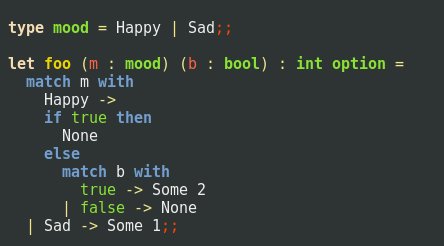
I'm learning OCaml at the moment, and I was caught out by the syntax today. This code (pictured) gives a type error saying that Sad is not a boolean. https://gist.github.com/Wilfred/ce4b7177f404a482b8fccc0044d15e4c
This is the classic 'dangling else' syntax problem, but with match statements rather than if statements.
Showing 331-345 of 657 posts