Most online stores seem to prefer explicit pagination rather than infinite scroll.
Perhaps infinite scroll is better for time-oriented content, unlike a catalogue? Or maybe it helps sales in some fashion?
Maybe Not by Rich Hickey: https://youtu.be/YR5WdGrpoug
Makes an interesting point on Maybe/Either: they require updating the call site, even for compatible changes! E.g. from returning a Maybe Foo to returning a Foo. Argues for *union* types.
I have days where I communicate more in written form than spoken.
Given the popularity of messaging on smartphones, and the frequency of emails in the average workplace, will we reach a point where text is the most common medium? Has it happened already?
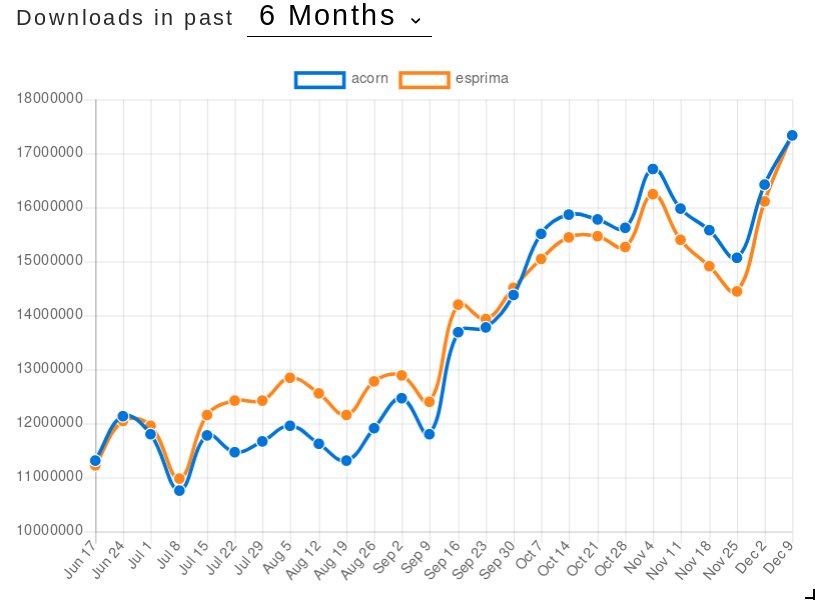
Usually, npmtrends is a great way of choosing a library that's widely used and probably more reliable and better documented. When choosing a JS parser, the options are remarkably close!
Several times a year I get emails from academic projects that have crawled GitHub and want to do surveys. I wish them luck, but there's a tragedy of the commons going on here.
If you pay users to store copies of your data, how do you ensure that they don't claim they have extra copies? An interesting problem! Public Incompressible Encoding for e.g. FileCoin: https://hackingdistributed.com/2018/08/06/PIEs/
Modelling foreign language learning in the Duolingo app by fitting a machine learning model! When you have millions of users you can measure recall effectiveness with a high degree of confidence:
Rust library bugs in FFI or other unsafe code blocks can have severe consequences, even remote code execution.
It's great to see that there's now a site for announcing security bugs in the ecosystem:
I had an interesting conversation today with someone who was starting out in tech, and asked me for advice.
I did my best to provide concrete, actionable suggestions:
Remarkable to hear that Microsoft is replacing edgeHTML and Chakra with Blink and V8 in Edge! https://techcrunch.com/2018/12/06/microsoft-edge-goes-chromium-and-macos/
As the article comments, by limiting Edge to Windows 10, it couldn't gain enough market share to get many web developers to support it.
Untyped programs don't exist: https://www.williamjbowman.com/blog/2018/01/19/untyped-programs-don-t-exist/
Demonstrates a simple theorem, but has a nuanced notion of types as invariants. It discusses the important questions of when we should check types, allowing escape hatches, and whether type checking should be decidable.

.png)