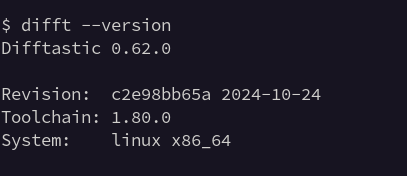
It's a small thing, but I'm much happier with --version in the latest version of difftastic.
It shows the release number and the commit date. This gives you a reproducible build with age info.
It also shows OS, arch and compiler, because those are useful in bug reports.
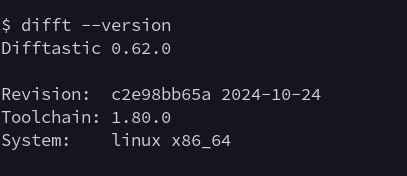
It's a small thing, but I'm much happier with the output of --version in the latest version of difftastic.
It shows the release version number, the commit hash, and the commit date. This gives you a sense of the age of release, but you still have a reproducible build (unlike build time).
It also shows OS, arch and compiler, because those are common requirements in bug reports.
New version of difftastic is out! In this release:
* Improved git integration
* Polished the side-by-side display, particularly on large screens
* Fixed a nasty crash
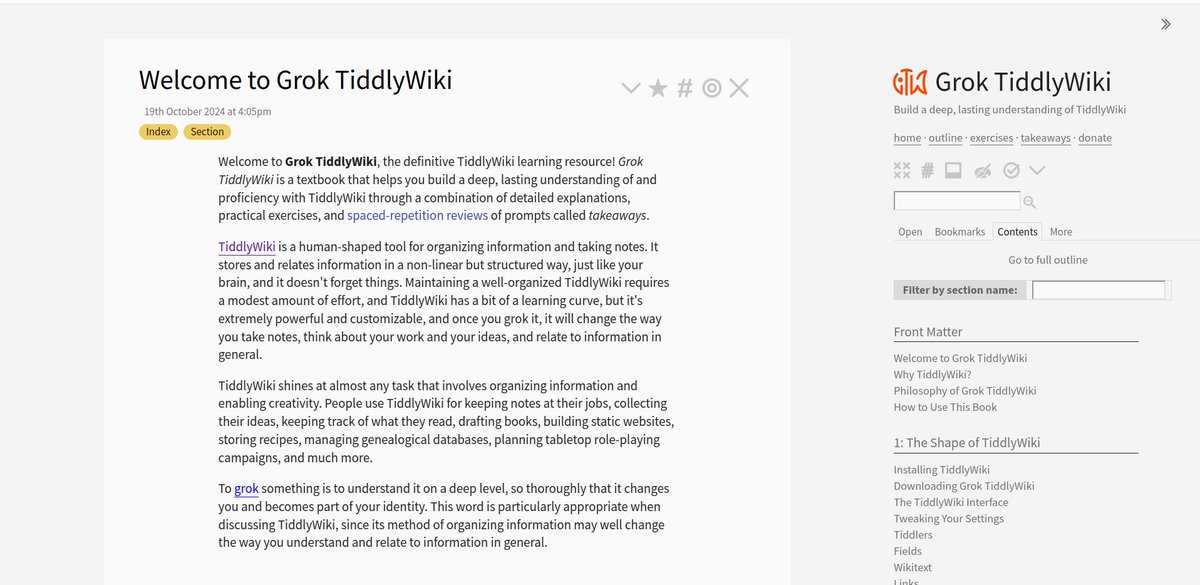
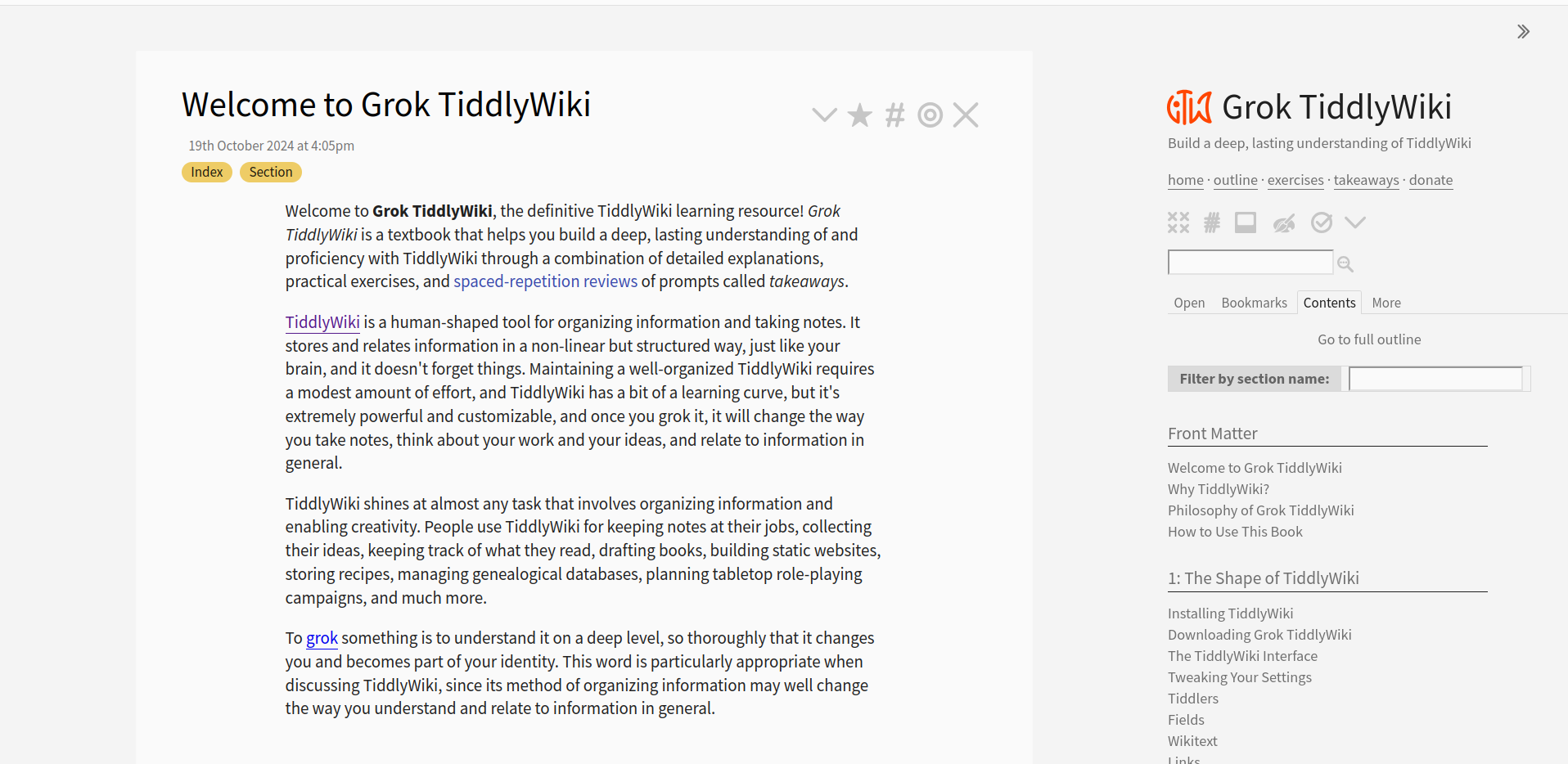
An interesting feature of the Grok TiddlyWiki interface: it has the sidebar on the right.
I see a sidebar on the left way more often, but arguably it makes more sense on the right for a wiki? The content is effectively more prominent.
In praise of Tcl, and reflecting on syntax features for a good command shell:
Whilst LLMs don't always give an accurate answer, the UI is really compelling. I keep finding users whose favourite way of doing research is an LLM.
TIL Drupal has a credit system to give preferential treatment to people and organisations who contribute regularly!
It's odd how lazy evaluation is generally seen as a niche design choice, yet the vast majority of languages treat `foo() || bar()` as short-circuiting.
It feels like rename is by far the most important refactoring operation. If I had an IDE with only one refactoring, I think I'd want rename.
@krinkle A surprising number of PL design workarounds are "just add another equals sign" 🙃
I really like the MELPA model of packaging directly from git. It solves the problem of forgetting to release something -- just merge a PR and you're done.
It also makes version number bumps much less important.
I really like the MELPA model of packaging directly from git. It solves the problem of forgetting to release something -- just merge a PR and you're done.
It also makes version number bumps much less important.
You could go even further in a statically typed language and also figure out when breaking changes occur.
TIL Tcl has a notion of 'safe interpreters', a mode where you can run untrusted code in a sandbox:
https://www.tcl.tk/man/tcl8.4/TclCmd/safe.htm
Not many programming languages have this, but it's way safer to include in the implementation than try to build as a userland library.
I'm adding a += operator to my programming language, because writing `x = x + 1` is tedious.
This opens the tricky design question of which operators should support this. Is += and -= sufficient, or do you expect things like >>= and **= to be available?
I would *love* a terminal emulator that treated each command as an atomic unit, so I can efficiently scroll between them.
Line-based scrolling is annoying when you've just run a command that output 1,000 lines.
Do any such tools exist?