Fabulous paper on the history of Emacs Lisp and its design:
miniblog.
Apple is designing laptops/desktops around their ARM chips!
https://arstechnica.com/gadgets/2020/04/report-apple-will-begin-selling-macs-with-its-own-processors-in-2021/
Apple likes integration, but I wonder what the top-end performance will be like. Benchmarks of PowerPC vs Intel were often hard to compare.
I'm comfortable with git, and recently learned mercurial, and I've concluded: commits are the wrong abstraction.
Work-in-progress and finished work are different concepts. Rebases and even branches are for WIP. Signing is for finished work. Timestamps and authors change for WIP.
Sending patches/PRs to projects creates asymmetric work. The maintainer needs to think about the future work it might create.
Fortunately CI running tests, checking formatting, even enforcing commit message style helps! Reducing the amount of work needed to accept a PR matters.
Continued improvements in rustc's compile times! I'm impressed they haven't reached the point of diminishing returns yet.
https://blog.mozilla.org/nnethercote/2020/04/24/how-to-speed-up-the-rust-compiler-in-2020/
Is there a proper term for "anonymous definitions"?
This is a style of programming where you avoid repeating the declaration name, so later renaming is trivial.
E.g. Rust's self type, or loop-recur in Clojure.
Mozilla Hubs is a really simple 3D chatroom that I've started seeing meetups use. It's a nice model: it works with both VR headsets and browsers!
https://youtu.be/YppUt2N811k
It seems like ``` has entirely won for code blocks in markdown/commonmark.
It's easier to write, and well supported. Are there any use cases for four space indents now?
I've heard of the "three-star C programmer" https://wiki.c2.com/?ThreeStarProgrammer but I think we should have "three semicolon lisper". When you're organising your code in sections, you're building major projects!
Lovely traceback polish in Java 14: reporting which expression returned null in foo().bar().baz()!
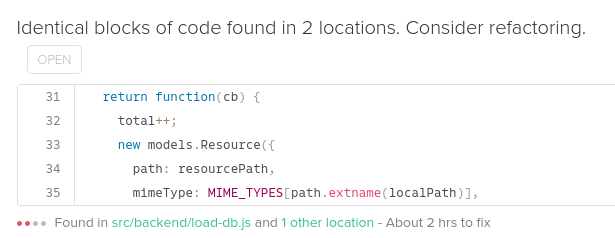
Here's a cute lint feature I haven't seen before: an estimate of how long an issue would take to fix!
Link: https://codeclimate.com/github/Wilfred/metawiki/issues?category=duplication&engine_name%5B%5D=structure&engine_name%5B%5D=duplication
(It's a really small project, so 2 hours seems pessimistic.)
I've been writing programming language documentation for objects. It's surprisingly nuanced!
How do you introduce objects to the reader? What elements should the first example contain? What order do you introduce concepts like methods, inheritance and properties?
GitHub is making multi-user private repositories free, and halving the prices of enterprise accounts!
Perhaps their costs are decreasing, or they have more competitors?

Running an HTTPS website with Let's Encrypt is increasingly becoming a built-in server feature.
For example, Traefik (a reverse proxy for web services) has this functionality in its default feature set!
reCAPTCHA is going to start charging a fee for use!
Showing 1,621-1,635 of 7,653 posts