Whilst s-expressions are no panacea, they do make some things shockingly easy. Partial application is simple and readable when AST==list.
miniblog.
Linear types make performance more predictable https://blog.tweag.io/posts/2017-03-13-linear-types.html (exploring linear types in Haskell)
Exploring a code viewing tool that allows you to rename functions and update the underlying code. Worried I'm reinventing Smalltalk.
Lispers aren't afraid of C macros, and that leads to remarkable loop constructs that handle circular lists:
I feel like JS can be very readable, but I find myself using 2 space indents due to extensive nesting. I'm going to try using Promises more.
Emacser (noun): a person who spends 45 minutes and 20 lines of code to save one keypress.
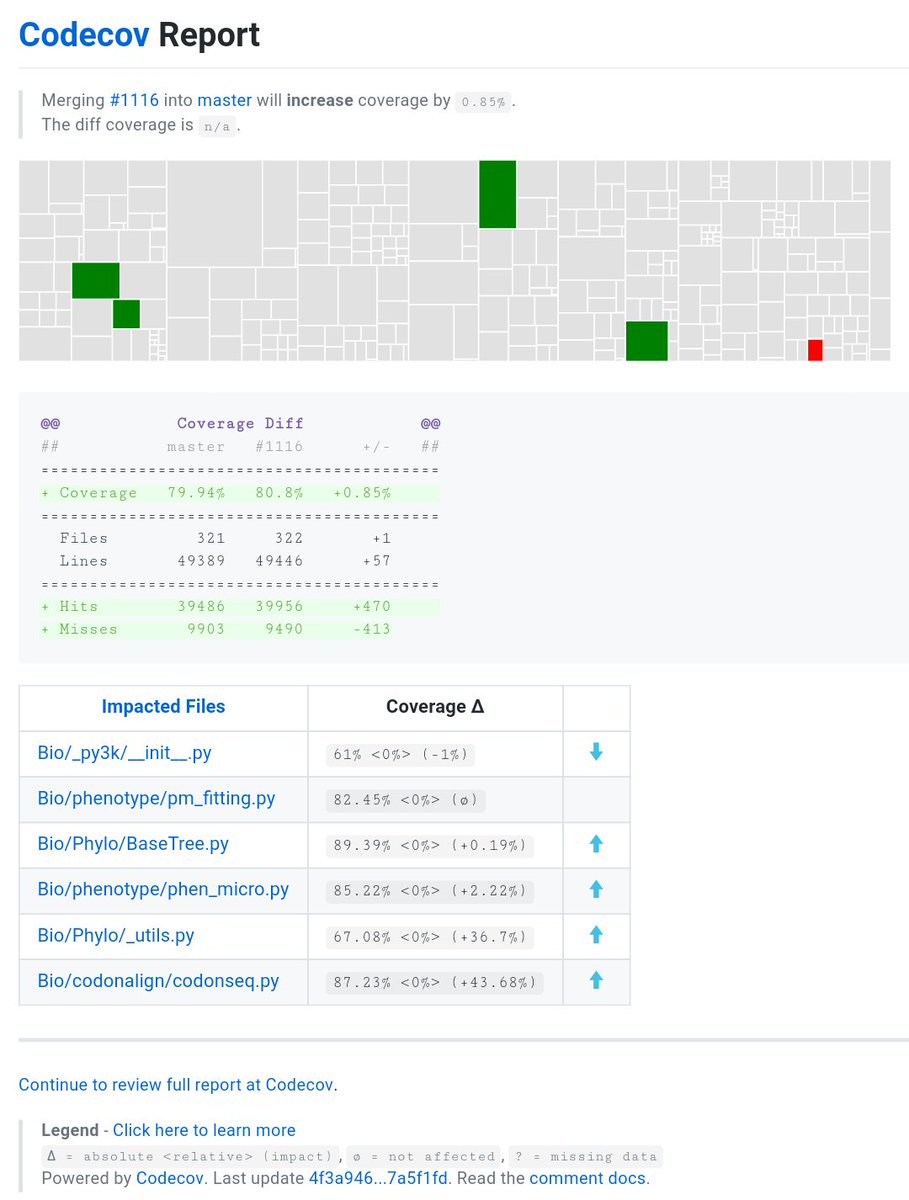
Rather than just reporting coverage numbers, codecov has started visualising coverage diff by files!
The lisper in me finds it silly that many PLs don't include a parser in the stdlib. You know the interpreter or compiler has one!
Useless interfaces and interface distillation https://ane.github.io/2017/03/23/useless-interfaces.html (only factor out an interface when you have multiple classes!)
Superb deep dive into how the Rust compiler infers lifetimes: https://stackoverflow.com/a/42639814 (much like type checking)

How do you understand dense lisp code? Code is data, so just walk the tree! I give a walkthrough with lispy.el:
Android is evolving with interesting new APIs in O: https://android-developers.googleblog.com/2017/03/first-preview-of-android-o.html (Wi-Fi Aware will enable proximity chat apps!)
Wow, Pypy now supports numpy and pandas! https://morepypy.blogspot.co.uk/2017/03/pypy27-and-pypy35-v57-two-in-one-release.html (a major reason for using CPython previously)
Showing 3,811-3,825 of 7,654 posts