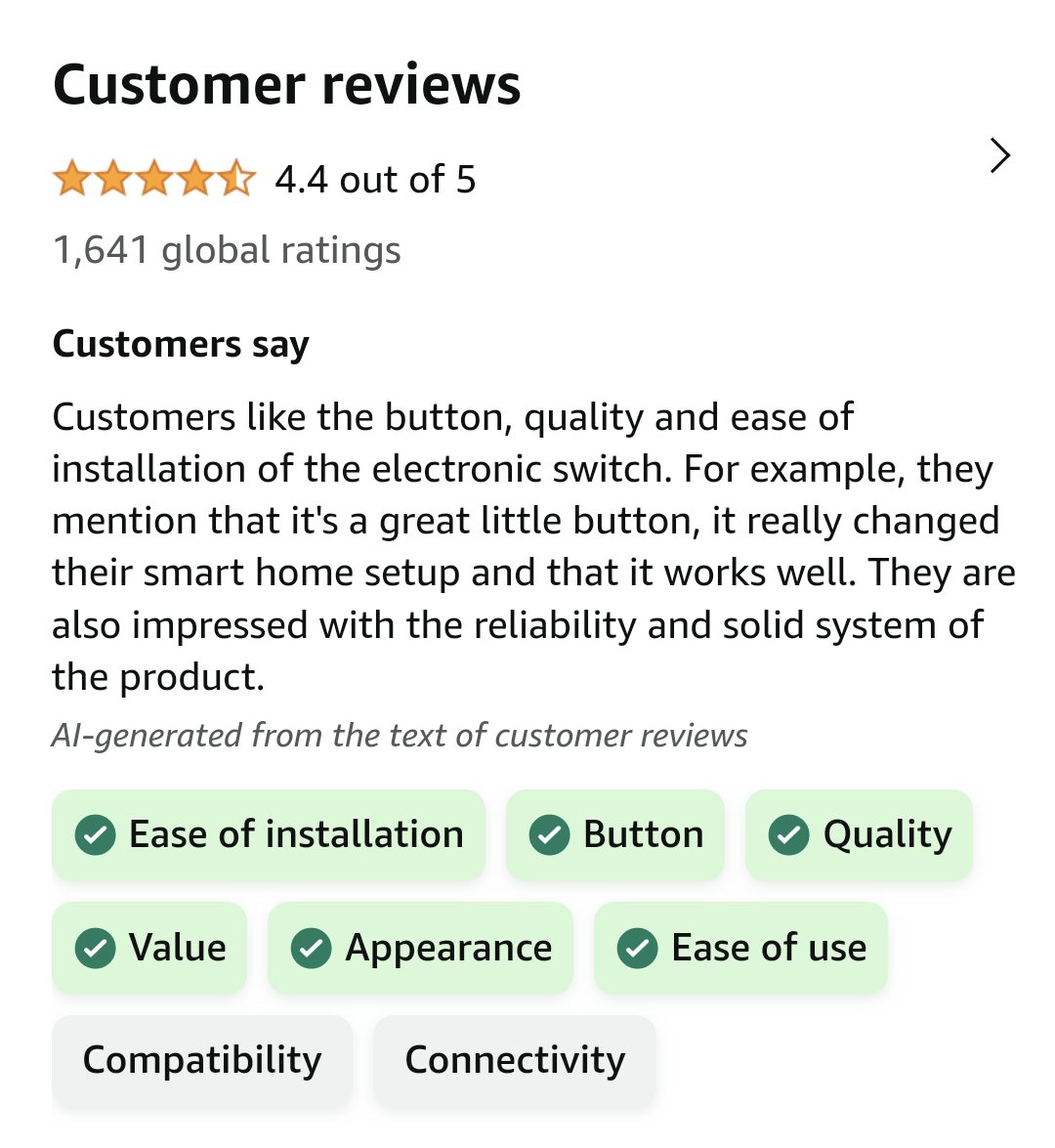
Amazon is using LLMs to summarise product reviews!
Seems like a great application of the tool, but I haven't seen many deployments of AI summaries in the wild yet.
Uniform function call syntax treats `fido.bark()` the same as `Dog::bark(fido)`.
This seems like a really nice way of representing methods in a language. Are there any downsides? There are plenty of languages without this.
My understanding of Rust Foundation and Rust Project has definitely improved following today's talk.
Rust Foundation: Handles financial, legal and bureaucratic stuff. Requires a supermajority of votes from both sponsors and the Rust Project.
Rust Project: Focuses on building.
I'll be at RustConf this week! Do say hello.
Seen in the wild: replace all the newlines with a literal $ in sed:
sed -e 's/$/$/'
It's always bugged me that regex replace syntax looks similar to regex, occurs close to the search syntax, but actually has a different meaning. It's harder to read.
I'm adding XML support for difftastic! Still needs some tweaking, but the initial results look promising.
XML is particularly fun because early academic research on tree-diffing focus on XML.
TIL that Pong was originally a warm-up exercise for a new employee at Atari!
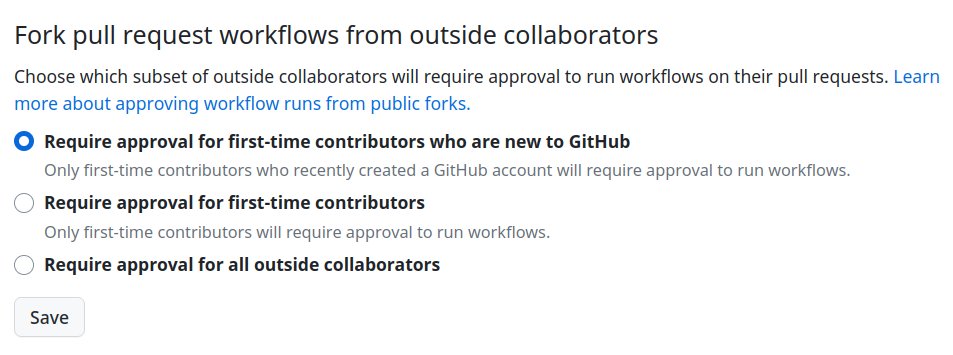
Ooh, I've just discovered that you can enable actions on GitHub pull requests by default! This is the actions settings page.
My understanding is that GitHub introduced these limits to prevent people trying to run cryptominers on GitHub actions. Sounds like GitHub has largely fixed it.
Today I learnt that the Glamorous Toolkit has its own VM, implemented in Rust, which wraps the Pharo smalltalk environment!
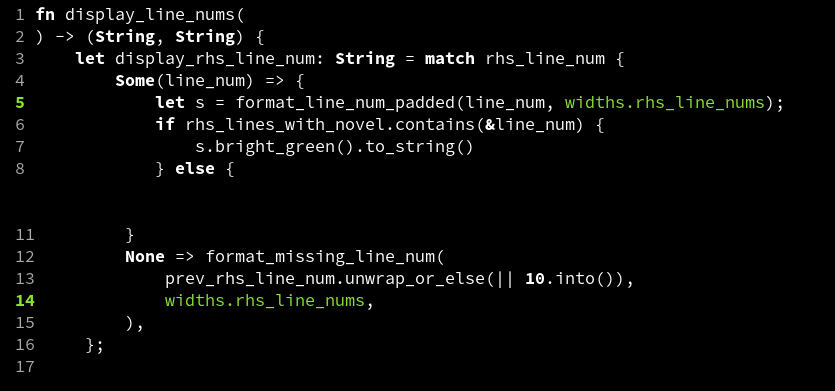
I've started highlighting constructors like Some and None consistently with type names in difftastic, and the results look so much more readable!
Distributing binaries built against musl is counter-intuitive to me. When I run them on my machine, they're dynamically linked to glibc!
The main advantage AIUI is that you don't depend on new glibc features, so you get a more portable executable.
Rust is the only language I can think of with a first party version switcher. rustup is maintained by the core team, unlike rvm or nvm.
Are there other languages like Rust in this respect?
OpenSSH will send packets at 20ms intervals to prevent network timings revealing what you're typing:
https://undeadly.org/cgi?action=article;sid=20230829051257
Really elegant solution!
Woah, the median price of a .sexy domain is over $2,000!
https://tld-list.com/tld/sexy
I like the emacs.sexy website, but that's a big chunk of money. The tld-list link above suggests that it's possible to buy these domains for more conventional prices.
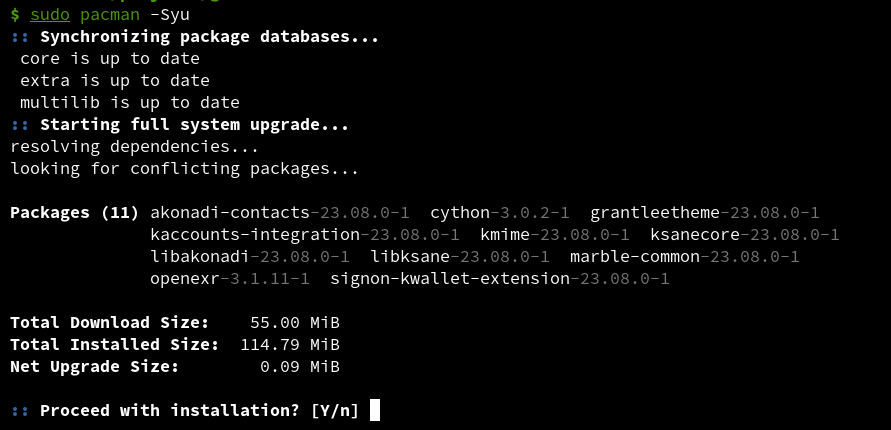
Just learnt that pacman, the Arch Linux package manager, has a colour option in /etc/pacman.conf!