Fantastic lisp-machine influenced 'language oriented kernel' on raspberry pi: http://t.co/CNuyhDh08Z
miniblog.
Rebol keeps coming up as a language with interesting metaprogramming features. Worth putting in some time to explore it.
Do syntax-aware diff tools exist? I'd like to see "in this commit: one function added, one parameter added to function foo".
Rust source code includes everything you need to generate basic tags!
Ordering compiler passes is a really interesting problem. When you get it right, each pass increases opportunities for the others.
Interesting to see ag beat pt in code search benchmarks: http://t.co/6YbJZRCyGk (I'd love to see measurements of other projects too though)
Sloccount says I have 360KLOC in ~/.emacs.d/elpa! Biggest packages are org, slime, helm, haskell-mode and magit (94, 45, 15, 14, 12 KLOC).
It's a shame unfollowing folks where 20% of tweets are great but 80% are boring (or not in English). Are there smarter Twitter clients?
In assembly, JMP may be encoded as various different opcodes, and compilers (LLVM here) carefully choose the best: http://t.co/fFSbavVxd6
I suspect there's a strong correlation between the age of a programming language and how much it uses UPPERCASE FUNCTIONALITY.
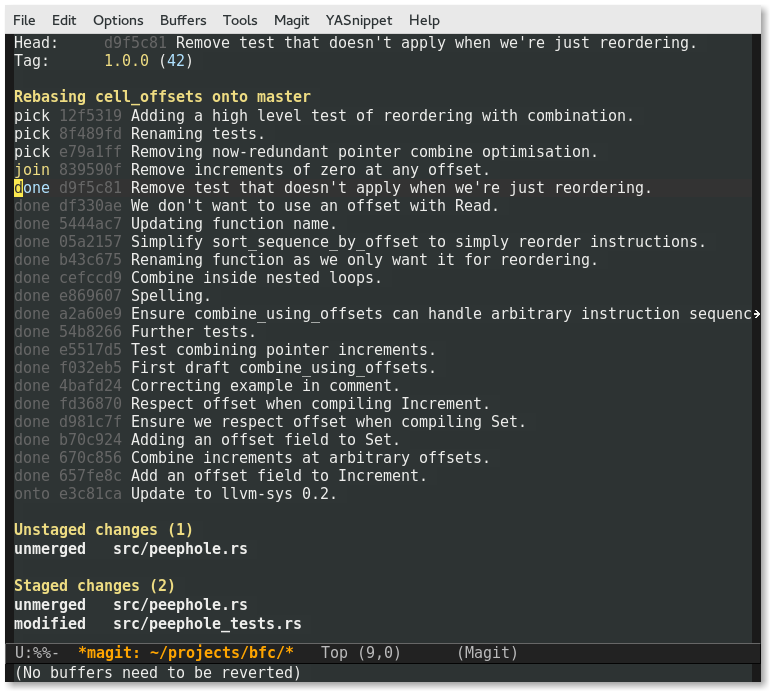
Another great @magit_emacs feature: when rebasing, you can see progress as you work through conflicting commits. http://t.co/5Zy2rCg8IF
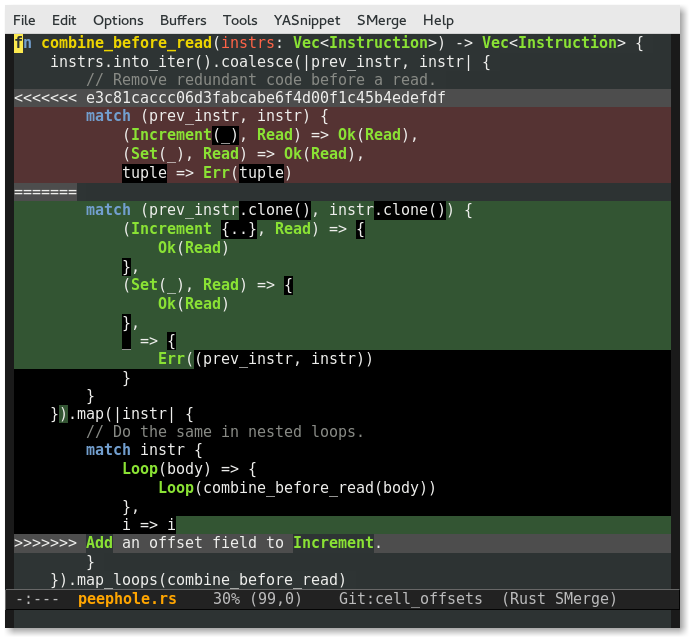
Today's Emacs tool: smerge. It highlights conflicts, differences and provides smerge-keep-current to choose between. http://t.co/hyO15HKAOl
Tons of useful rust APIs are being stabilised in 1.4!
Fascinating discussion of the different programming paradigms explored during the development of Eve:
Emacs package of the day: ido-vertical https://github.com/creichert/ido-vertical-mode.el The minibuffer is too small -- a bigger display helps find things faster!
Showing 5,131-5,145 of 7,653 posts