GitHub is adding an API that will allow linters to automatically fix your code for you: https://blog.github.com/changelog/2018-05-23-request-actions-on-checks/
I suppose it's the next logical step, but it will be lovely when I can apply compiler fixits from the comfort of a PR :)
miniblog.
Cute project being trialled in California: use a monochromatic display for your rear license plate!
https://www.theverge.com/2018/5/30/17409112/digital-license-plates-california-reviver-auto
I can certainly see the personalisation value and the utility for large car fleets, but it could introduce a whole new genre of popup adverts.
Thoughtful post about just how much harder is to write code as soon as you transition from text to graphics, and how that influences our default programming habits:
An opinionated, unofficial alternative to https://crates.io/: https://crates.rs/
I like the understated design, and having multiple websites listing the packages available is a great sign of a healthy ecosystem!
Running the typescript compiler *inside* BigQuery, and building a dataset of one million typescript files to see how people use the language!
https://medium.com/@urish/yes-i-compiled-1-000-000-typescript-files-in-under-40-seconds-this-is-how-6429a665999c
Worthwhile article on how the value of developers on your platform depends on the size of your userbase: https://stratechery.com/2018/the-cost-of-developers/
More users means you don't need to work as hard to acquire devs.
Also discusses why MS benefits from buying GitHub.
Scuttlebot is a P2P replicating datastore designed to facilitate decentralised applications: https://scuttlebot.io/
The list of available apps is impressive for a young project: https://github.com/ssbc/ssb-handbook/blob/master/applications.md
The apps remind me of IPFS' ambitions, although the protocol is different.
Excellent article on giving worthwhile criticisms, and getting value from criticisms from others: https://chappellellison.com/giving-and-taking-criticism/
Glitch is exploring a git alternative where edits are continuously committed, then you have a slider that lets you move between historical states. Less powerful, but much more approachable!
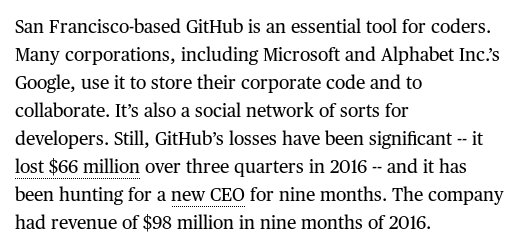
Looks like it was difficult for GitHub to maintain independence: it wasn't profitable for much of 2016:
There's a great playlist on YouTube that shows the highlights of Doug Engelbart's amazing tech demo from 1968: https://m.youtube.com/playlist?list=PL76DBC8D6718B8FD3
It's an integrated dev environment, hypertext system, structured text, and even allows multiuser collaboration!
Really interesting post on optimising the Rust compiler: https://blog.mozilla.org/nnethercote/2018/06/05/how-to-speed-up-the-rust-compiler-some-more-in-2018/
I love that the author comments that he still finds lifetimes somewhat scary. You can even work on the compiler without needing to master advanced Rust techniques!
I worry about the traditional computing term 'augmented human intellect'. If I wear a watch, I'm an augmented human: I can track time more accurately than I could without technology!
What's a better goal for tech regarding how it can help us achieve things?
I'm curious to see what impact Microsoft's purchase of GitHub has on the long term prospects of Atom.
Atom is a lovely editor pushing the boundaries of web tech amd editor design in several areas, but its usecase is similar to VS Code. Would MS want to fund three editor teams?
These days I struggle to distinguish between machines using Xorg and those using Wayland. I think that's a testament to the compatibility of Wayland and the efforts put in by the Qt/Gtk folks.
Showing 391-405 of 657 posts