The most common selling point I hear for Nix is having a list of all the packages you need.
On a traditional Linux distro, I just install things and forget about them. A curated, commented list would certainly be handy when I have a new system.
Today I learnt that you can mix HTML inline in markdown! For example, the following is valid.
Foo <hr/>
I'd assumed that you needed HTML separately, like ``` blocks, but no:
https://spec.commonmark.org/0.31.2/#raw-html
Admittedly HTML is very restricted on most sites, but it's helpful for SSGs.
Spent a bunch of time learning about text diffing algorithms this evening.
"Myers Algorithm" refers to a specific paper written by Eugene Myers, and he published faster algorithms later!
https://tigerbeetle.com/blog/2025-02-27-why-we-designed-tigerbeetles-docs-from-scratch/ has an interesting distinction between "physical" and "logical" hash of a tarball.
By storing the hash of the decompressed tarball contents (i.e. the logical hash), they can verify the validity of files without needing to keep the tarball around.
One day I am going to reach the height of technological sophistication, and every clock in my house will handle daylight savings automatically.
I'm not there yet. I think modern appliances are getting better though.
(Does a microwave really need to know the current time?)
I really like base-2 prefixes in writing, e.g. 1 KiB, 2 MiB, 3 GiB and so on. It's way more explicit.
However, SI units are k M G and so on. Switching between lowercase k and uppercase Ki keeps tripping me up.
@MekahimeAkari @lifning "C makes it easy to shoot yourself in the foot; C++ makes it harder, but when you do it blows your whole leg off". -- Real Stroustrup quote, 1986
I've heard of a 'burger menu' when a button has three horizontal lines on it, but today I heard 'kebab button'. This is similar, a button with '···'. Clearly UI designers are hungry.
I've heard of a 'burger menu' when a button has three horizontal lines on it, but today I heard 'kebab button'. This is similar, a button with '···'. Clearly UI designers are hungry.
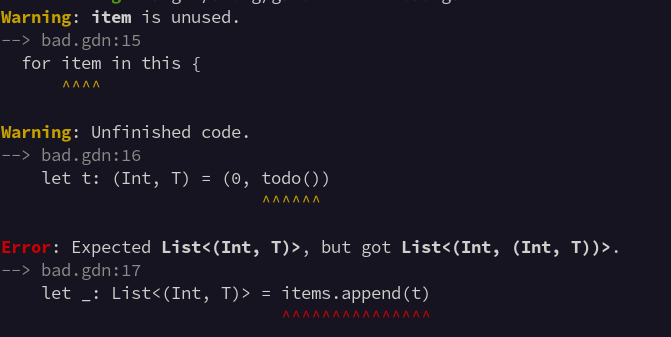
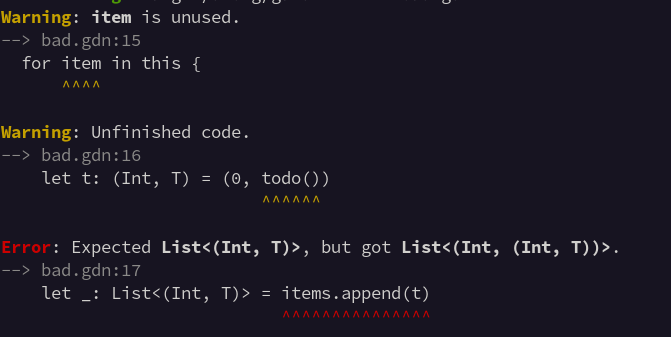
Doing another iteration on my diagnostics display. I'm reasonably happy with the bold highlighting within the error message.
I'm not sure about the colour on Warning and Error though. It gives the output some visual structure, but arguably the message itself is more important.
Overall it seems like the Rust for Linux is making huge strides. Greg KH is super supportive of it[1] and the wider Linux community is pretty positive[2] (see all the quotes at the end of the slides).
1:
https://lore.kernel.org/rust-for-linux/2025021954-flaccid-pucker-f7d9@gregkh/
2:
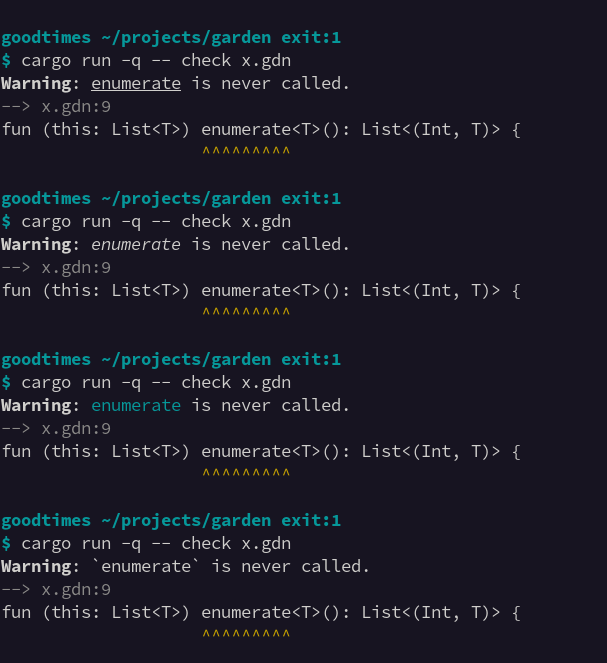
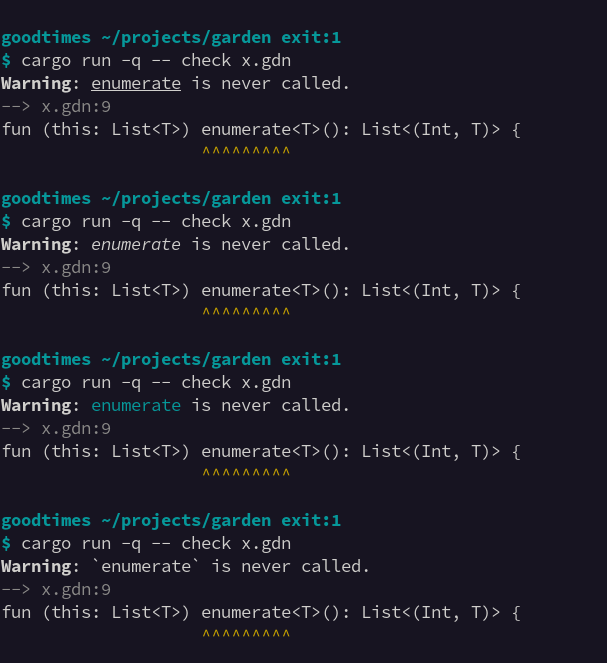
Do you have a favourite way of highlighting text in a CLI error message? Currently I'm using backticks, but I'm wondering what's the most readable.
I hear people say that Go is often hard to search online (hence sometimes "Golang"), but the vast majority of language names are common words. Names with punctuation (C++, C#) are hard too.
Is this a big problem in practice? "Perl" isn't a dictionary word, but it's an exception.
Copilot doesn't offer a way of disabling completion inside comments. People have discovered a comical workaround: swearing in the comment!
In LSP, a position is represented as a line number and a column offset (in Unicode code units):
https://microsoft.github.io/language-server-protocol/specifications/lsp/3.17/specification/#position
This is pretty elegant. You'll get the correct line regardless of encoding bugs, and the editor already knows the line number so it's cheap to compute.