This is incredibly impressive: bootstrapping rustc from only a C++ compiler!
miniblog.
A neat dictionary of programming terminology, with a urban dictionary approach to definitions:

Dealing with merge conflicts is an important skill that I've seen many experienced developers struggle with.
My experience might be biased from helping teams migrate from svn to git, but I've seen problems with all VCS.
Remarkable, sobering discussion of how hard it is to write bytes to a file robustly: https://danluu.com/deconstruct-files/
APIs are subtle, filesystems have different safety modes, they sometimes discard errors, not everyone complies with POSIX, and sometimes hardware doesn't meet its spec!
An ARM engineer has written an interesting critique of instruction and encoding choices in RISC-V, and how those decisions can impact implementations:

A critique of RISC design, and why CPUs end up with custom instructions: https://blackhole12.com/blog/risc-is-fundamentally-unscalable/
(RISC-V has explicit support for extensions, so I think it will be less of an issue there. The idea that webassembly will make programs more portable is interesting.)
Docker is rather nice for throwaway shells. If I need a shell with a command that I don't have on my server, I can install it, perform the task, then throw away everything.
Nifty example of a Haskell lens library using custom type errors to explain what's wrong:
https://github.com/mrkgnao/silica/blob/master/README.md
I've worked on JS projects where we set a maximum line number on files. It worked well -- it was a gentle reminder that a module had grown and would benefit from splitting up.
(I think this would definitely work in other languages, but probably with a higher line threshold.)
It's common in technology to deal with incredibly large numbers, so you eventually develop an intuition for different orders of magnitude.
Perhaps we should use the same prefixes elsewhere? E.g. the world has 7.5 gigapeople and US national debt is 22 petadollars.
I find markdown easy to work with, but the syntax is pretty lightweight and my content is mostly prose.
Perhaps WYSIWYG has an edge for more complex formatting? E.g. if a paragraph is largely links it can be much harder to read the markdown source.
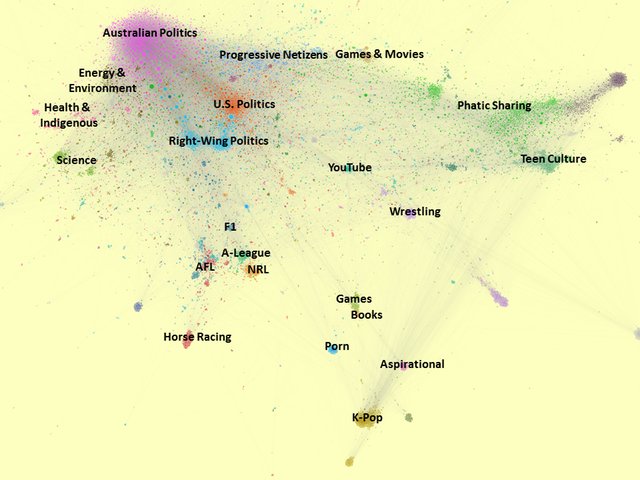
What do people discuss on Twitter? How much is politics versus other topics?
An analysis and visualisation from @qutmedia at
Transitioning from manual to automated processes, and the role of documentation:
Shower thought: Docker has taken the concept of a bundled .jar or statically linked binary and made it available in a language agnostic way.
I received a "thanks for your open source projects" email this week! :)
I receive these once every year or two, and they're lovely. If you have really benefited from an open source library or tool, telling them can brighten up the author's day!
Showing 1,996-2,010 of 7,653 posts