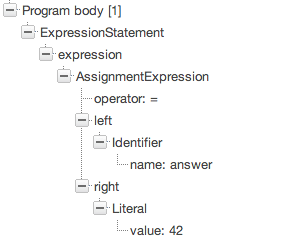
Understanding surprising JS syntax by visualising the parse tree:
miniblog.
One weakness of online discussion is protracted debates or arguments. What if commenting systems only allowed one comment per user?
(Assuming a robust mechanism to prevent duplicate accounts.)
'Golden tests' are tests that deliberately save expected output to a file, to make them easy to examine or regenerate.
https://ro-che.info/articles/2017-12-04-golden-tests
I'm familiar with the concept, but it's nice to see a handy label for it.
If you're interested in alternative approaches to computing, I strongly recommend exploring the ideas in the Tunes project.
There's a good overview here:

GitHub is exploring some really interesting editor designs with Xray: https://github.com/atom/xray/blob/master/README.md
It uses CRDT to represent text (rather than rope data structures) and mixes web tech (primarily JS) with Rust to produce a design that's fast but still extensible.
Whilst I've seen many teams use monorepos successfully, it assumes that there's a common contribution process for everyone.
A PL community needs to have different projects with different processes, and that requires packaging tooling. I wonder what the size upper bound is.
Great introduction to the AV1 video codec, inter/intra frame compression, and exploiting correlations to save bytes: https://people.xiph.org/~xiphmont/demo/av1/demo1.shtml
The Xiph posts are always good with great explanatory diagrams/sample pictures.
This is very cool: dynamically adjusting an Emacs theme based on the amount of ambient light:
Wow, gcc's codebase is amazingly lispy in places: prefix syntax with parentheses, foo_p for boolean functions.
It's natural to worry about the practicalities of new designs. There's a wonderful discussion in https://medium.learningbyshipping.com/nikon-versus-canon-a-story-of-technology-change-45777098038c about camera owners worrying about *batteries* being unreliable. Times have changed!
Good article on RSS on Techcrunch: without helping users with curation, or giving publishers metrics on what is read, it will continue to be supplanted by competitors:

Git 2.17 has some really nice diff tweaks: colouring lines that have moved without modification, and even showing context by function rather than just N lines!
Fun post on building IDE features into Excel: https://blog.querystorm.com/index.php/2018/04/04/whynow/
Paxedit is a nifty Emacs project that goes beyond paredit: https://github.com/promethial/paxedit/blob/master/readme.org
It understands e.g. (setf x 1 y 2), where you want to transpose pairs of expressions. It's also smart enough to allow you to operate on the sexp containing point, without you needing to move!
Showing 2,971-2,985 of 7,654 posts