The Indian supreme court has ruled that Google must allow third party app stores on the Google app store under antitrust laws:
miniblog.
Cases where it makes more sense to use concrete types rather than generics, even if you can be generic:
Rust's RFC 3191 will let libraries package debugger scripts so you get a better experience when using gdb or windbg:
Defining a separate tests module so rust tests compile faster:
What's the best keyword for function definitions?
My current hypothesis is that you want it to be short, but still pronounceable, so `fun` is the sweet spot.
I've really come to appreciate OCaml's notion of generics. It doesn't have subtyping, so e.g. you have an `int list` or an arbitrary `'a list`, but nothing inbetween.
As soon as you add constraints like Java's `List<? as Foo>` it become incredibly hard to produce good errors.
Switching between Rust and TypeScript, I really miss the Result type in TypeScript. I can kludge something with nullable types or exceptions, but it's not as nice for the caller.
The Servo browser has funding for active development again!

Today I learnt about crossterm, a Rust crate for interacting with terminals in a cross-platform way: https://docs.rs/crossterm/latest/crossterm/
It handles things like is_tty() and terminal::size(), which are hard to support correctly in both Linux and Windows. I might port difftastic.
I have mixed feelings about the equality trait in Rust.
I have types where sometimes I want to compare by structure, and sometimes compare by reference.
I can only implement Eq for one, so which do I pick?
I feel like in-code docs are an underexplored design space.
Do you use comments or string literals? Before the function (e.g. JSDoc) or inside it (e.g. Python)?
Which is best? Which is the easiest to write, has the easiest tooling, or the most readable (code/HTML) artifacts?
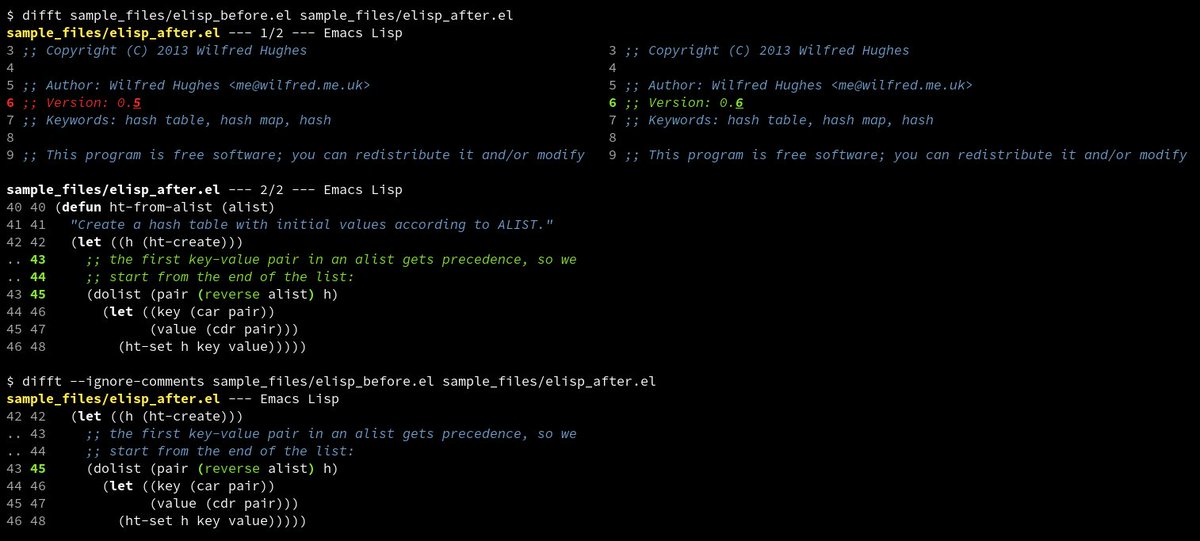
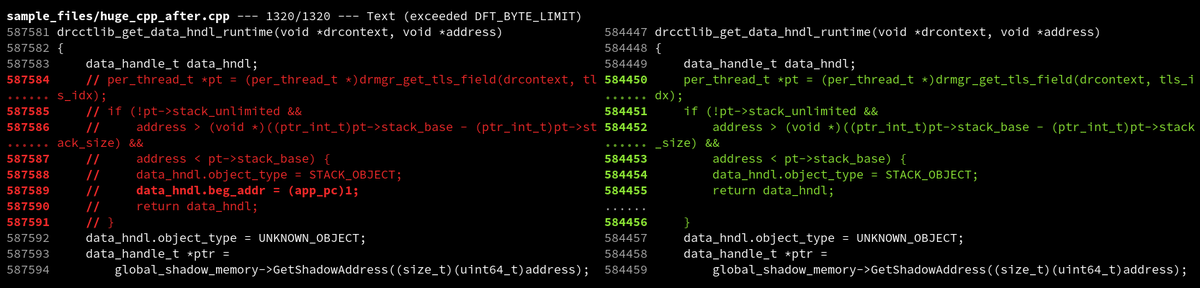
I've released difftastic 0.42! In this release:
* Faster textual diffing (over 10x if files have few lines in common!)
* There's now a syntactic diffing option --ignore-comments, for when you only want to see code changes
Is Forth really a memory-unsafe language? I'm struggling to picture what e.g. a use-after-free would look like in such a minimal programming language.
Today I learnt about a cunning trick used by GNU diff to make Myer's algorithm faster: https://github.com/mitsuhiko/similar/issues/15
If you do an initial pass to find items that only occur on one side, you can discard them before diffing! They'll always be shown as changed.
The docs model for R packages is really interesting. Every package has docs as a PDF file, and the package server supports 'vignettes' (standalone tutorials) as a first class artifact!
E.g.

Showing 601-615 of 7,652 posts