One nice thing about quadratic algorithms: if you can reduce your N, you get a really nice speedup.
miniblog.
I think I've used fewer third party libraries in bash scripts than in any other language. I just use the built-ins and invoke binaries.
I can't think of any other programming language where the stdlib felt like it was sufficient.
YAML is a funny language: it's not Turing complete, but it can have arbitrary code execution bugs.
On the limits and perils of being data driven: https://twitchard.github.io/posts/2022-08-26-metrics-schmetrics.html
(Worthwhile improvements are often not amenable to A/B testing, and metrics can harm intrinsic motivation.)
I've just released difftastic 0.34: https://github.com/Wilfred/difftastic/releases/tag/0.34.0
Minor release, but it fixes some build issues introduced in 0.33, so worth upgrading if you've had any issues with 0.33 :)
It's perhaps appropriate that a programming language database has its own syntax for entries! https://github.com/breck7/pldb/commit/bde872b5b8e1cf9fb3114c1fbf3c40e405b5388d
It looks like a simplified YAML I think.
PLDB is an ambitious project to catalogue all the different programming languages out there: https://pldb.com/lists/languages.html
It's showing a ton of potential (over 4,000 items recorded!) although it's still pretty young (I just fixed the LLVM IR comment syntax).
The bottom type has a different name in a bunch of languages. I've seen nothing, _|_, !, never and empty.
I don't know which is the most approachable to users though. `List[Empty]` reads very nicely for an empty list, whereas `never` reads nicely for error functions.
I've heard of quines, but today I learned about radiation-hardened quines! https://en.wikipedia.org/wiki/Quine_(computing)#Radiation-hardened
These are quines where *any* single character can be removed and they still function. Fun concept, seems easier in a language with eval().

TIL about the box.leak() method in Rust: https://doc.rust-lang.org/std/boxed/struct.Box.html#method.leak
This leaks the box, but it also gives you a reference that can live longer! E.g. you can leak a Box<u64> and treat it as 'static.
It makes sense, but being able to use a value after leaking is new idea to me.
@takloufer@fosstodon.org @emacsomancer Fascinating, an authoritative slide! Thanks for sharing :)
I admire hobbyists who build their own kernels, but the size of modern systems is intimidating. Even something like a Bluetooth stack is bigger than historic kernels, and tends to require multiple people.
I think it's just the cost of compatibility? Tech collaboration is hard.
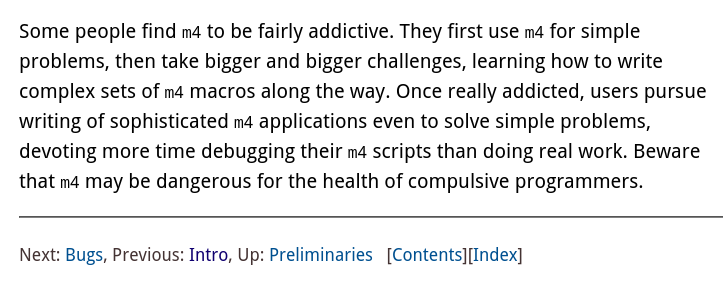
Sure, your templating language might be good, but is it so good that the manual includes a warning for addiction? 🙃
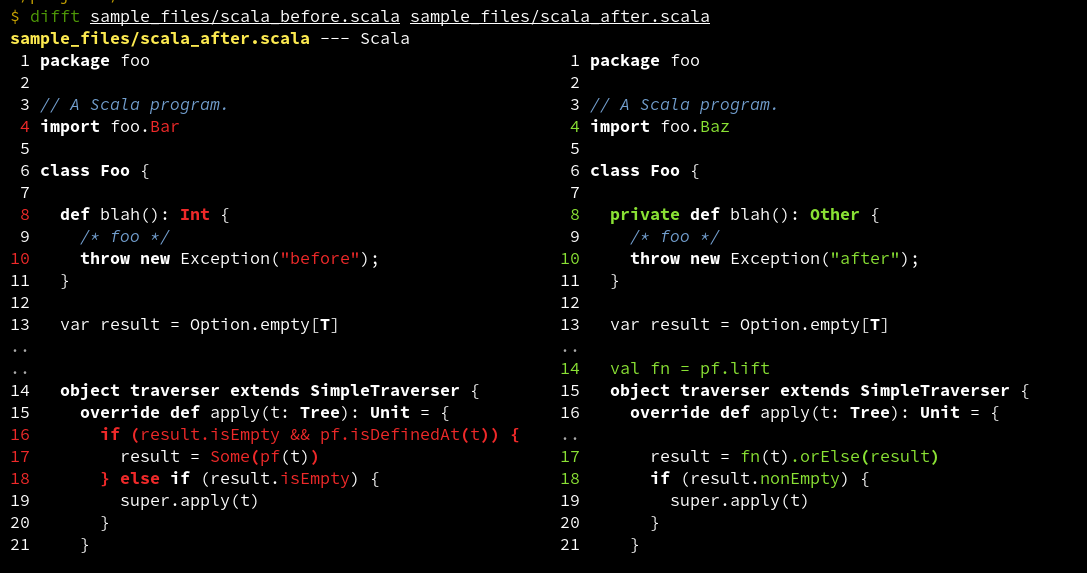
I've released difftastic 0.33!
I'm really pleased with the results in almost every case I've tried: it's handling nesting way better. This Scala example has improved substantially over 0.32.
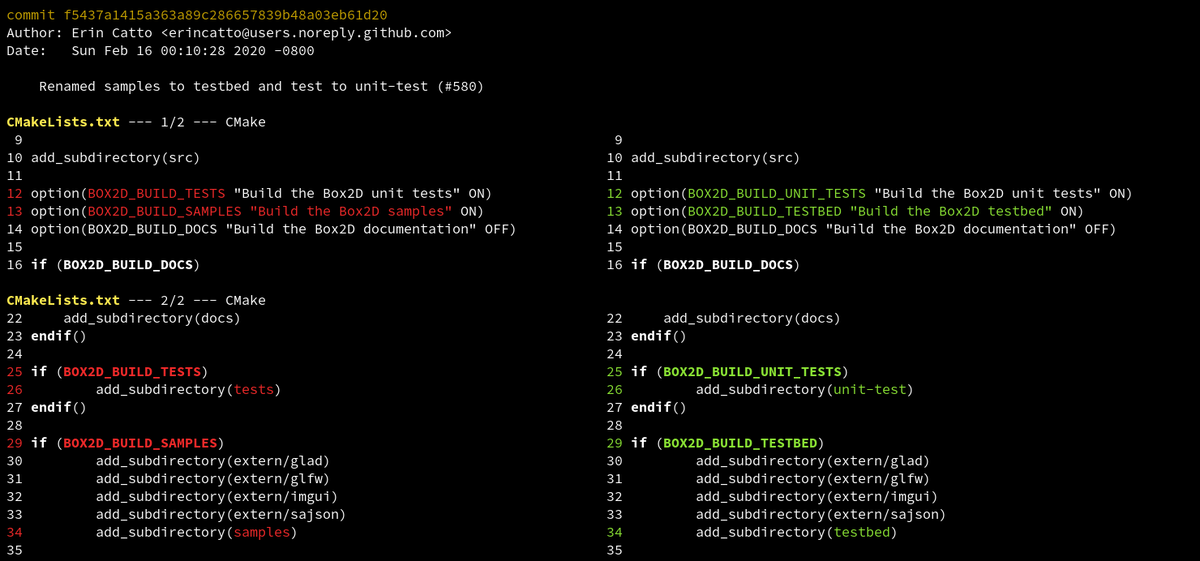
Oh, and some bug fixes and I've added CMake support :)
I've realised that the Haskell 'slogan' "avoid success at all costs" is ambiguous.
It can be parsed as "avoid success, at all costs" or "avoid success-at-all-costs". I'm not always sure which meaning is intended.
Showing 781-795 of 7,652 posts