GitHub now allows you to group your starred projects into lists: https://github.blog/changelog/2021-12-09-lists-are-now-available-as-a-public-beta/
miniblog.
LLVM is moving mailing lists to Discourse!
I'm a big fan of Discourse's ability to summarise threads and richer formatting options.
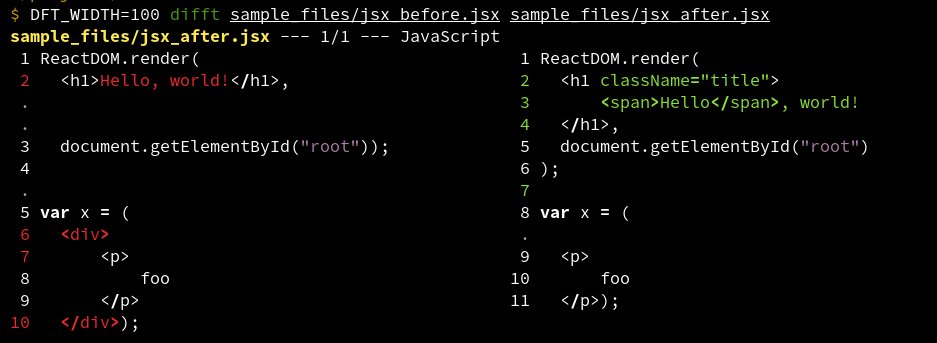
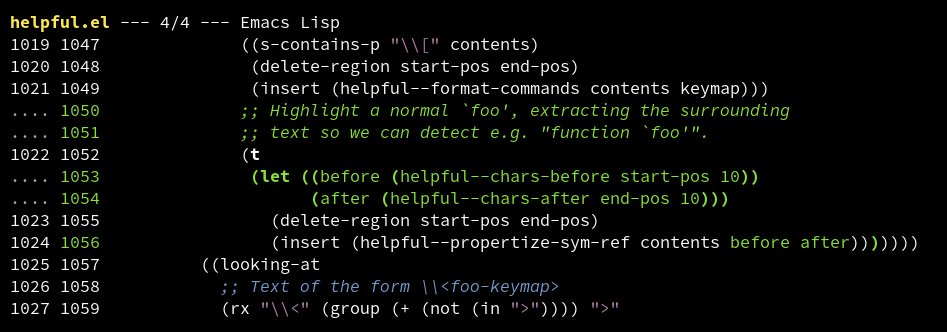
Line alignment is a *massive* problem in syntactic diffs. Line-based diffs don't have this problem -- either lines are equal or they aren't.
In this example, it's not clear whether line 11 on the right should align with line 9 or line 10 on the left.
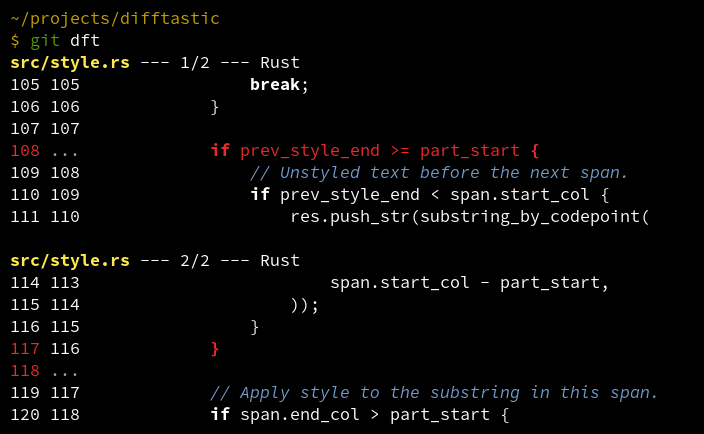
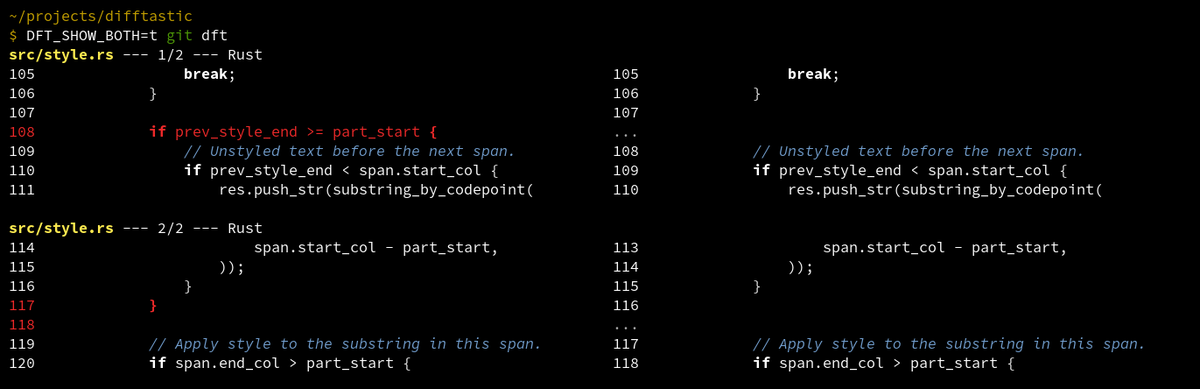
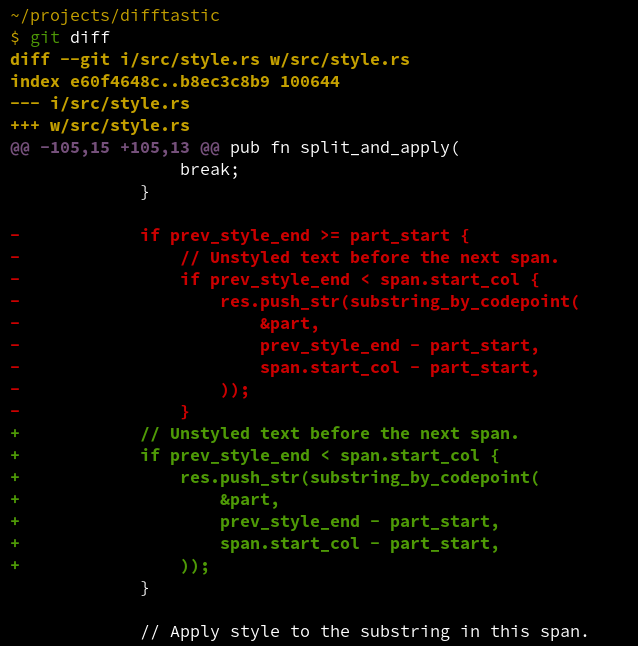
I'm really pleased with how well difftastic handles removal of `if` statements. Here's an example I hit today.
It's definitely harder to see which curly braces are removed in the `git diff` example. `git diff` does combine everything into a single hunk though, which is nice.
I've been consistently impressed by the Doom Emacs community. I get really high quality bug reports (sometimes patches too!) from both the users and the maintainer :)
I wish that build tools considered *current* CPU and memory utilisation.
$ make -j $NUM_CPUS
This is problematic if some jobs use a lot of memory (common in linking) or if you're using your machine for anything else.
Difftastic 0.20 is out!
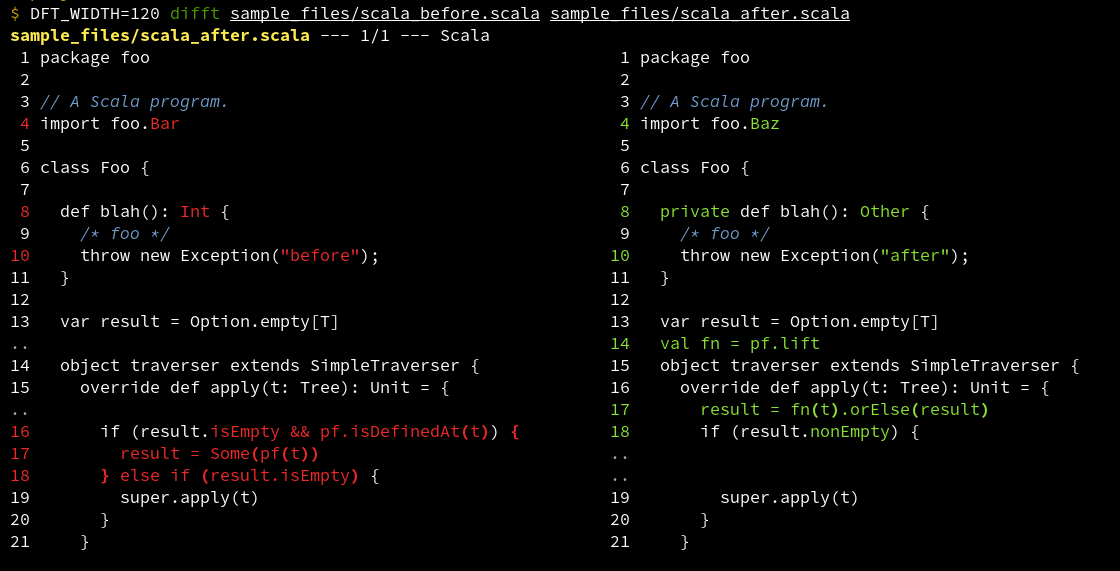
* Better handling of nesting changes, based on autochrome. This fixes some nasty corner cases (Python screenshot) and gives nicer results in general (Scala screenshot).
* Better handling of large files, even multi-megabyte!

RISC-V seems like a great example of "commoditise your complements". If you're getting value higher in the hardware or software stack, a royalty-free ISA is valuable.
Creating an ISA is a ton of work. Once it's basically viable, it creates interesting opportunities.
I really like languages where private functions are fewer keystrokes than public functions.
Unfortunately 'protected' is longer than 'public', or 'pub(crate)' and 'pub'.
Have any languages solved this? E.g. 'fn foo', 'pkg fn foo', 'public fn foo' would work.
Robin Hood hashing, and a remarkable bug in Rust where building one hash map from another can have quadratic performance!
https://accidentallyquadratic.tumblr.com/post/153545455987/rust-hash-iteration-reinsertion
@janriemer@mastodon.technology @friend Not spam at all!
Thanks, I'd not seen that, and it looks really well suited to my needs :)
@friend @janriemer@mastodon.technology Sounds like a good choice! I recently found this interesting benchmark table which shows Blake as a great cryptographic hash: http://cyan4973.github.io/xxHash/
(FWIW difftastic uses rustc-hash for its hashing needs.)
Git repositories have the lovely properties that deletes aren't propagated. Shared/cloud storage sync deletes across devices.
Accidentally deleting content in a local git repo, and even pushing it, is a safe operation.
Fun fact: for simple text diffs, difftastic is now constrained by terminal output performance!
I halved instruction counts for diffing a 300KLOC text file against "" and I only went from 8.2 seconds to 6.5 seconds.
Most of the code I write is in a garbage collected language.
I'm often surprised how much extra performance I can get when I can control allocations. I saved ~10% runtime in difftastic by moving to a zero-allocation colour library (owo_colours)!
Showing 946-960 of 7,652 posts