Are there any nice cross-platform ways to trigger a notification from a terminal?
I've been using
https://pushover.net/ but you need to use a browser and it's noticeably slower than the native options.
(Pushover is great for mobile notifications though.)
Terminad is a really interesting approach to rendering markdown in the CLI. It deliberately doesn't render links, so you can always see both the link text and the URL.
In a browser you have hover to see URLs, but not necessarily in a terminal.
Should code completion offer private methods/fields?
If the user chooses a private method, you can offer a quickfix to change its visibility. It's clutter though.
I frequently find myself wanting fields that I haven't exposed yet, and frustrated that the IDE hides them.
Blogged: Devlog 2: The Importance of Sandboxing
Exploring PL opportunities when you have a first-class sandbox.
Is there a good canonical name for autofixes, where a static analysis tool can apply a change to resolve an issue?
Clang calls them fix-its, LSP calls them quickfixes.
I've realised that AGENTS.md / CLAUDE.md solve two distinct problems:
* It tells the LLM the conventions of the project, avoiding follow-up prompts.
* It precomputes a summary of the project, saving a bunch of searches at the start of a session.
Igalia's post on self-hosting CI runners is a masterclass in build engineering. It shows dealing with weird API constraints, but still finding good designs.
I also learnt that some CI systems use OCR on Apple's installers to automate!
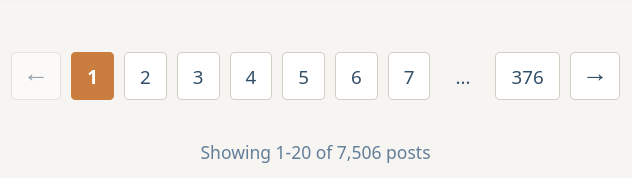
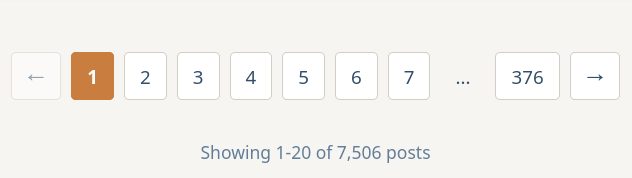
I've been experimenting with different pagination UIs.
It's so common to have arrows, but I've realised they're redundant here. When you have the adjacent values as well as the final value, you don't need > and >> arrows too.
Thoughts?
In many respects I feel an LLM benefits from a monorepo. I've vibe coded a bunch of helper CLIs recently and end up repeating the same preferences for all of them.
I want all my CLIs to use clippy, parse arguments with clap, etc. They're distinct tools in distinct repos though.
I think you could build an interesting IDE with a tiny embedded LLM in addition to the usual tooling.
Features like 'extract method' would be much nicer if an LLM could provide a name. Choosing a good name is virtually impossible from just a typed AST.
Delighted to see that TOML has released a new version! TOML is overall a great standard but I understand they had limited people with the power to cut a new release.
You can often estimate the age of a website based on how well it displays on mobile.
All my sites end up with media queries in the CSS for narrow screens. It's so hard to design a single UI that scales from phone to desktop otherwise.
I find it odd that people recommend Docker for sandboxing agentic coding tools. Isn't it easier to just create a separate user account on the machine?
It's an established security boundary, and viewing output is easy (just make the user's home directory world readable).
I'm never sure what to name my remotes in git. I tend to use 'mine' so I can add other forks later, but sometimes I use 'gh' or the traditional 'origin'.
What do others use?
Caddy is really growing on me. It's nice having a web proxy that includes letsencrypt functionality without any additional configuration.
I've tended to use nginx with a separate letsencrypt setup for projects before, and it's much more awkward.