I've just released difftastic 0.34: https://github.com/Wilfred/difftastic/releases/tag/0.34.0
Minor release, but it fixes some build issues introduced in 0.33, so worth upgrading if you've had any issues with 0.33 :)
miniblog.
It's perhaps appropriate that a programming language database has its own syntax for entries! https://github.com/breck7/pldb/commit/bde872b5b8e1cf9fb3114c1fbf3c40e405b5388d
It looks like a simplified YAML I think.
PLDB is an ambitious project to catalogue all the different programming languages out there: https://pldb.com/lists/languages.html
It's showing a ton of potential (over 4,000 items recorded!) although it's still pretty young (I just fixed the LLVM IR comment syntax).
The bottom type has a different name in a bunch of languages. I've seen nothing, _|_, !, never and empty.
I don't know which is the most approachable to users though. `List[Empty]` reads very nicely for an empty list, whereas `never` reads nicely for error functions.
I've heard of quines, but today I learned about radiation-hardened quines! https://en.wikipedia.org/wiki/Quine_(computing)#Radiation-hardened
These are quines where *any* single character can be removed and they still function. Fun concept, seems easier in a language with eval().

TIL about the box.leak() method in Rust: https://doc.rust-lang.org/std/boxed/struct.Box.html#method.leak
This leaks the box, but it also gives you a reference that can live longer! E.g. you can leak a Box<u64> and treat it as 'static.
It makes sense, but being able to use a value after leaking is new idea to me.
@takloufer@fosstodon.org @emacsomancer Fascinating, an authoritative slide! Thanks for sharing :)
I admire hobbyists who build their own kernels, but the size of modern systems is intimidating. Even something like a Bluetooth stack is bigger than historic kernels, and tends to require multiple people.
I think it's just the cost of compatibility? Tech collaboration is hard.
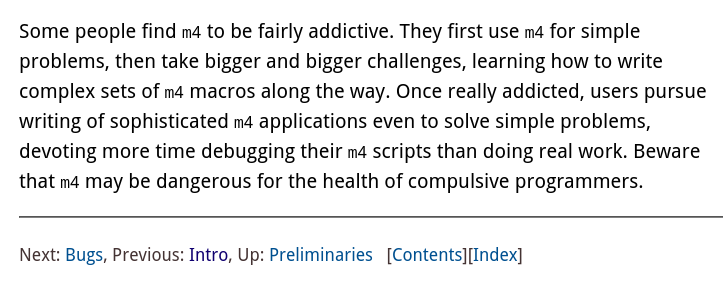
Sure, your templating language might be good, but is it so good that the manual includes a warning for addiction? 🙃
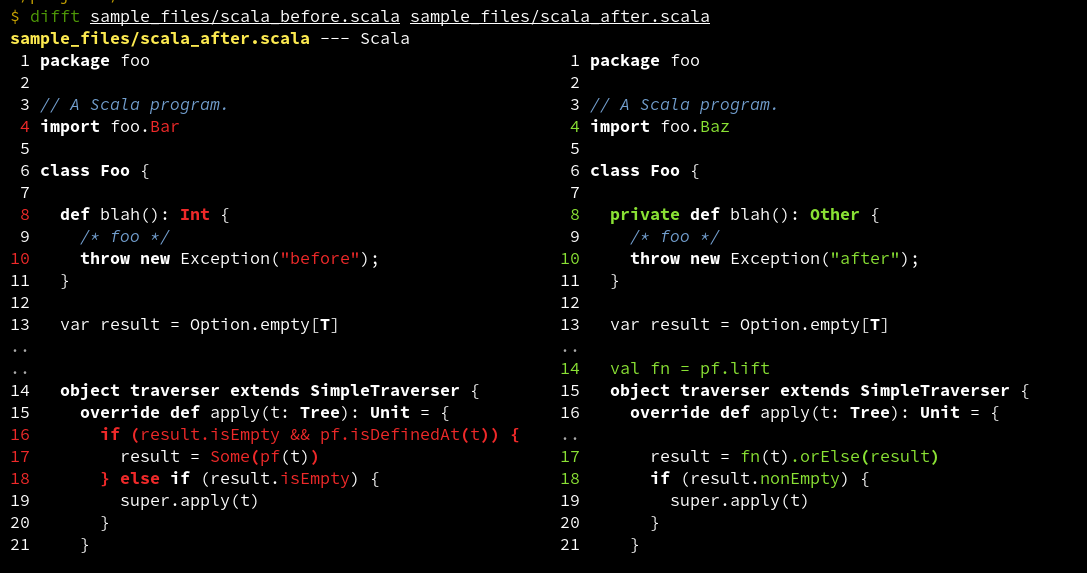
I've released difftastic 0.33!
I'm really pleased with the results in almost every case I've tried: it's handling nesting way better. This Scala example has improved substantially over 0.32.
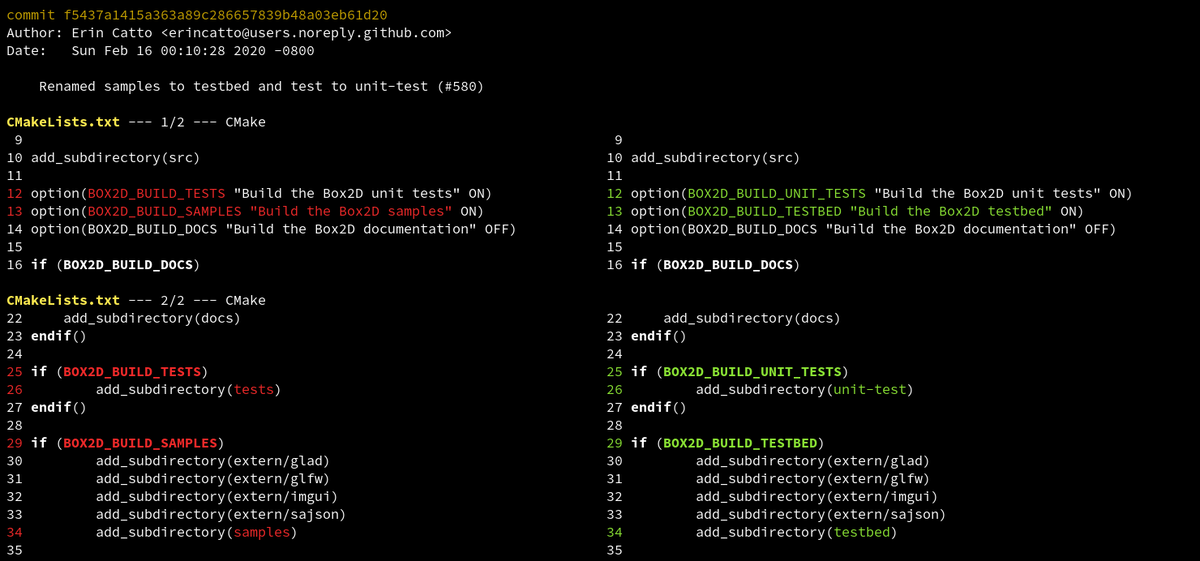
Oh, and some bug fixes and I've added CMake support :)
I've realised that the Haskell 'slogan' "avoid success at all costs" is ambiguous.
It can be parsed as "avoid success, at all costs" or "avoid success-at-all-costs". I'm not always sure which meaning is intended.
Fascinating talk on applying deep learning to detecting cheaters in CS:GO https://www.youtube.com/watch?v=kTiP0zKF9bc
The presenter discusses how they get machine-readable data out of matches, and how they still keep a human in the loop (ML just feeds the human analysis component).
My favourite pull requests are PRs that are obviously correct after you've read the description.
I've been learning some CMake, and it's a weird language. "ON" is used for booleans, it puts code in .txt files, but it still has a lispy macro system.
I suspect the vast majority of people (including me) learn CMake from a large preexisting build. That will bias impressions.
@krinkle@mastodon.technology I don't know of anyone using difftastic by default, including me! (I use it >50% of the time though.)
I toyed with background colours but I didn't find anything that I really liked. Contrast is hard, and depends on the user's theme.
Background colours look bad with syntax highlighting (e.g. red background with blue comment text).
It also looked silly due to ignoring whitespace between symbols.
It's an interesting space and I'm still experimenting :)
Showing 151-165 of 384 posts