Difftastic 0.36 is out! In this release:
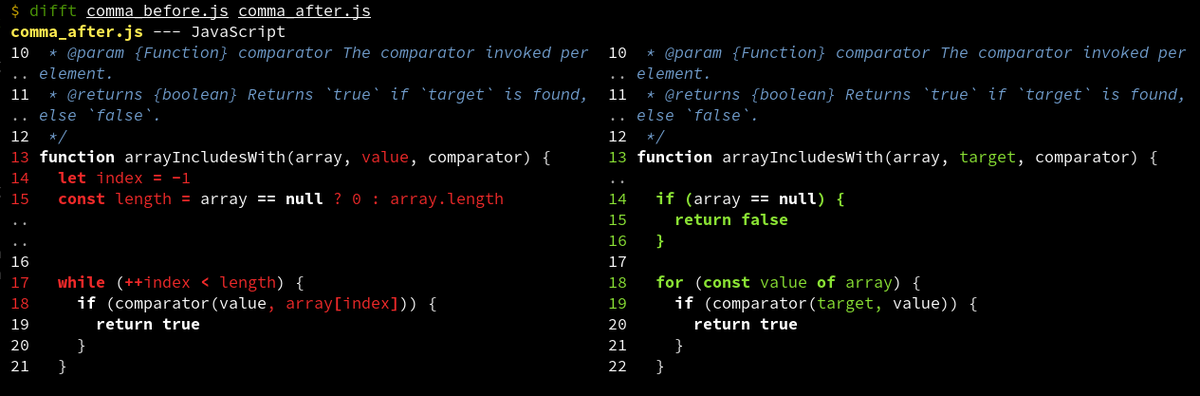
* Better diffs: Punctuation is now treated separately in the cost model
* Nicer display: Changes in comments are now underlined too
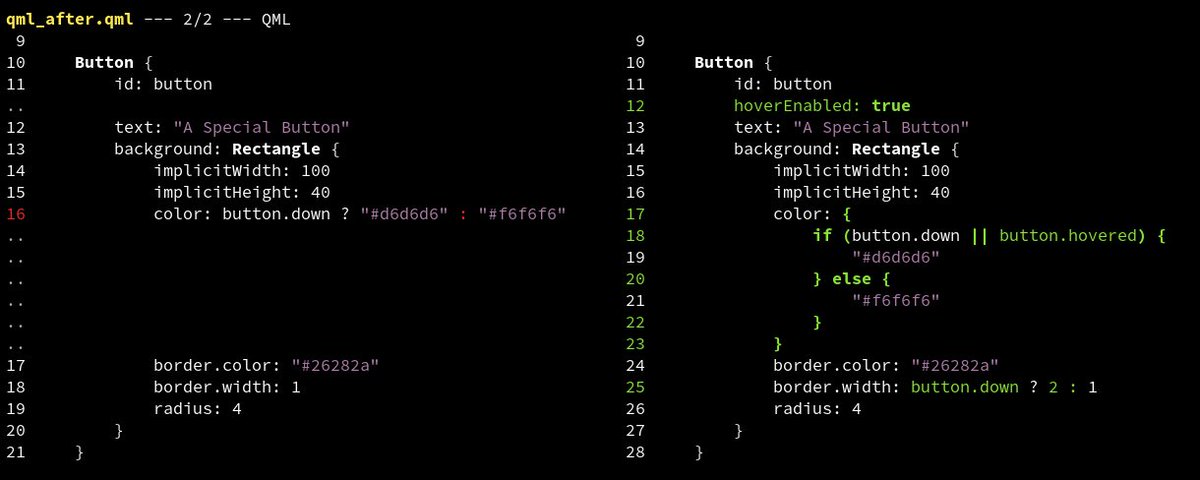
* New languages: Hare, Pascal and QML
* Smarter detection of binary files
Shower thought: Printing runtime values is far more useful for product types than sum types.
For a struct it's useful to see all the fields, but for a nullable int it's less useful to see 123.
I tend to shy away from automatic, implicit behaviour in software. I've seen CMake setups where FindFoo.cmake is automatically picked up for configuring the Foo library.
What are examples of tools with a larger amount of automagic behaviour that you like?
One habit I've picked up from blogging is putting *important statements in bold*.
It's a really helpful technique, in moderation. It doesn't seem to be common in print media though.
"Slots" seems to have almost entirely fallen out of favour relative to "properties".
Python uses both terms, are there any other cases where languages distinguish?
Neither Spotify nor Skype use peer to peer functionality any more.
Are there any consumer apps that still leverage P2P designs? Has bandwidth just become so cheap that it's unnecessary?
https://blog.phronemophobic.com/dewey-analysis.html is an absolutely delightful post quantifying Clojure usage.
Functions outnumber macros 20:1, the most popular single letter variable is x, and 63% of projects have zero mutable references!
Today I learnt that Scheme (1975) is actually older than Common Lisp (1984)! I'd assumed that Scheme designs were a response to CL.
Many of the CL features were created earlier, in fairness. CL was standardising the feature set.
As Rust grows in popularity as a systems language, I expect that someone will develop a dynamic language explicitly designed with great interop in mind.
C++ games seem to use Lua for this, and I've seen Java projects use Groovy.
Are there any up-and-coming contenders for Rust?