On the remarkably large feature set of format strings in common lisp, and comparing with an s-expression based syntax alternative:
miniblog.
Today I learnt about the NonNull<T> type in Rust: https://doc.rust-lang.org/nightly/core/ptr/struct.NonNull.html
It's a *mut T that is never null. Rust is trusting you even more than a normal *mut T, which is slightly daunting.
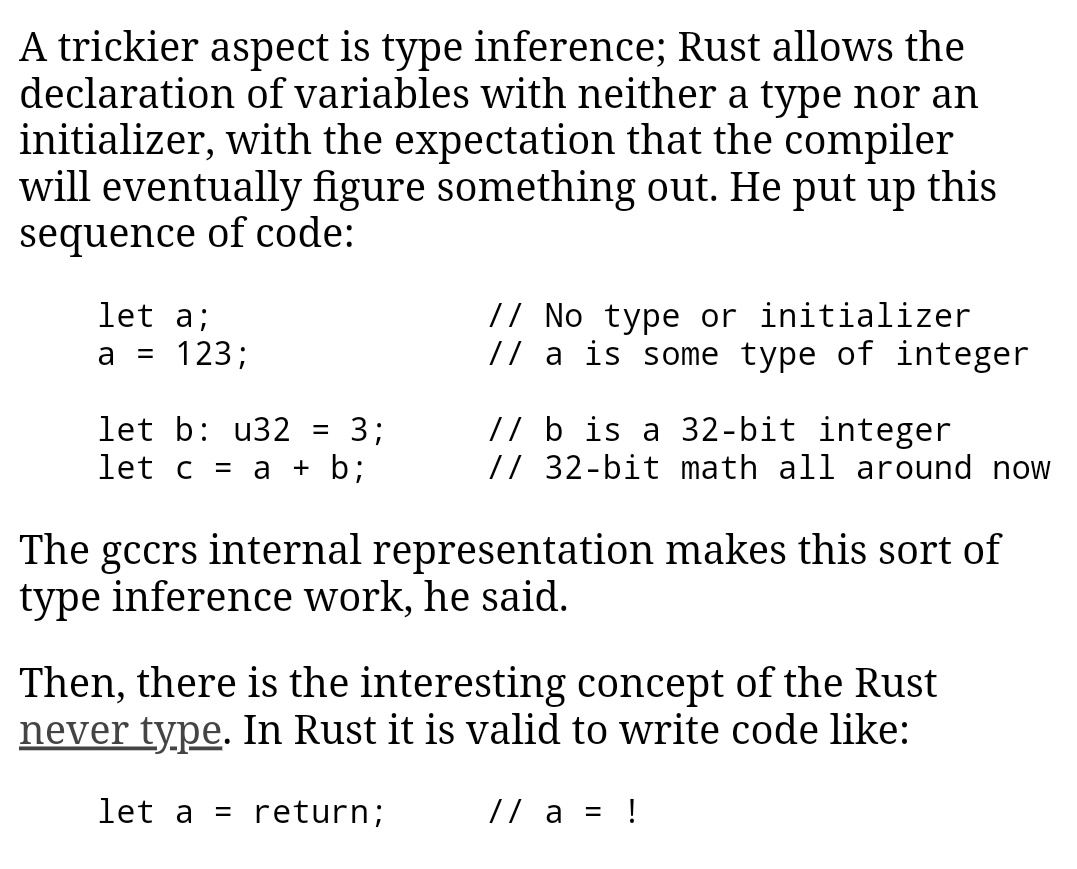
Some fun examples of things you can do with type inference in Rust, from a GCC-rust contributor.
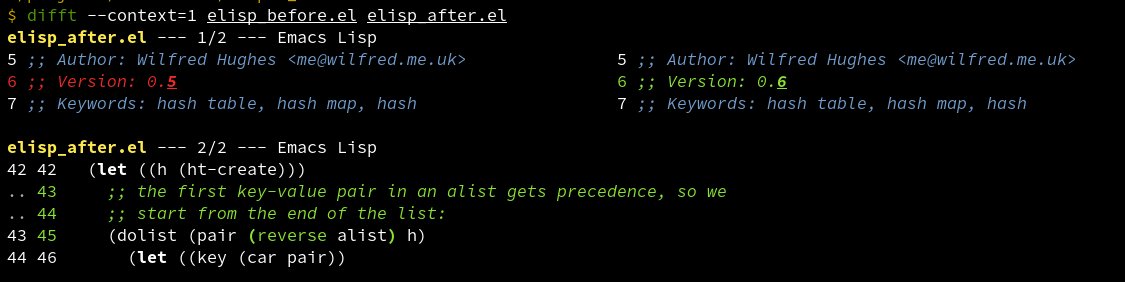
I've released difftastic 0.37!
* Improved performance, both runtime and memory usage (thanks to QuarticCat)
* Added --context=N to adjust how many contextual lines are shown
* Better Swift support
* The manual is now available in Chinese

Perhaps the biggest driver of docs success is prestige. How cool are the docs tools, and how proud are you to have contributed to the docs?
Which tools do this best? Racket docs look pretty great, for example.
The different layers of the Nix ecosystem, and the overlay system to allow downstream users to override (c.f. dynamic binding):
IDEA's Fleet editor is reminiscent of GitHub Spaces: a web-first IDE that enables users to start coding without needing to set up the environment locally on their machine: https://blog.jetbrains.com/blog/2021/11/29/welcome-to-fleet/
Interesting to see design convergence in this space.
Superb discussion of Go semantics for `for` loop variables, the challenges of breaking changes, and the tradeoffs of static analysis:
@friend It seems like people find Zig comptime easier to reason about, hence the interest in introducing it to other languages.
That seems worth something. I still prefer Lisp/Clojure style macros over safer Scheme/Rust macros. Lisp macro implementations are closer to typical code.
@friend sqlite is a great example!
I used to use a Proper Database Server (typically postgres) for my hobby projects, but I'm so glad I switched. Initial deployment is way easier and my data is always pretty small.
comptime generics in Zig and template style generics (checked at the call site) versus concept style generics (checked at the definition site):
It's funny how markdown has won in so many tools for prose, but doc comments syntax is so varied.
Rust and Julia are largely markdown, Python is ReST plus doctest syntax, and Java even an HTML dialect!
zmv is a mv alternative bundled with zsh that has an expressive globbing syntax. In many cases it can replace loops, and it even has a dry run option!
https://filipe.kiss.ink/zmv-zsh-rename/
Strategies for ramping up, working effectively and having fun when you're not using a mainstream programming language: https://morepablo.com/2022/09/so-you-re-using-a-weird-language.html
On programming language longevity, design niches, and the importance of community continuity:
Showing 91-105 of 384 posts